What Is a Crypto Portfolio Tracker? (And Why Balance Isn't Enough)
Most crypto apps show your balance. A real portfolio tracker shows what you actually made. Here's the difference and why it matters for your money and your taxes.
Open your favorite crypto app right now. Look at your portfolio balance. That number is almost certainly not what you actually made.
Your balance shows the current market value of everything you hold. It does not account for what you paid, the fees you spent along the way, the staking rewards you already claimed as income, or the losses you realized on trades that are no longer in your portfolio. It is a snapshot of what your holdings are worth today. It is not a measure of your performance.
This is the gap that most crypto investors live in without realizing it. They see a balance of $15,000 and assume they're up. But if they invested $18,000 across three exchanges over two years, paid $400 in gas fees, realized $1,200 in losses on trades that already closed, and received $600 in staking rewards they already owe income tax on, their actual position is very different from what the balance screen suggests.
A crypto portfolio tracker closes that gap. It tracks not just what you hold, but what you paid, what you earned, what you lost, and what you owe.
What a Portfolio Tracker Actually Does
A portfolio tracker connects to your exchanges and wallets and maintains a running record of every transaction: every buy, sell, swap, transfer, staking reward, airdrop, gas fee, and DeFi interaction. From that record, it calculates the numbers that actually matter.
Net worth is what your holdings are worth right now. This is what balance trackers show. A portfolio tracker shows this too, but it is just the starting point.
Cost basis is what you originally paid for each asset, including fees. This is the foundation of your profit and loss calculation. Without it, you cannot know whether you actually made or lost money. For a deep dive on cost basis and the five ways it breaks, see our cost basis guide.
Realized gains and losses are the profits or losses from trades you already completed. If you bought ETH at $2,000 and sold it at $3,000, your realized gain is $1,000. A balance tracker does not track this because the ETH is no longer in your portfolio.
Unrealized gains and losses are the paper profits or losses on assets you still hold. If you bought BTC at $40,000 and it is currently worth $85,000, you have a $45,000 unrealized gain. This matters for tax planning, especially for tax-loss harvesting decisions.
Net income includes staking rewards, airdrops, mining income, and other earnings. These are taxable as ordinary income when you receive them, and a portfolio tracker records the fair market value at receipt as both income and cost basis. For the full breakdown of how DeFi income is taxed, see our DeFi tax guide.
Fee tracking captures every gas fee and exchange fee you paid. Gas fees are taxable dispositions of the token used to pay them. Exchange fees adjust your cost basis. Over hundreds of transactions, cumulative fees can run into thousands of dollars. Most balance trackers ignore them entirely.
The scale of this problem is easy to underestimate. During the NFT and memecoin booms, network congestion pushed Ethereum gas fees to hundreds of dollars per transaction. People minting NFTs or trading newly launched tokens were paying $200, $500, sometimes $800 in gas for a single on-chain interaction. Every one of those gas payments is a taxable disposal of ETH that runs through your FIFO lot queue. If you made 50 mints at an average of $300 in gas, that is $15,000 in ETH disposals that need cost basis calculations, and most people never tracked them.
DEX trading adds another layer. Slippage on decentralized swaps can eat up significant percentages of a trade, especially on low-liquidity tokens or during volatile conditions. And in extreme cases, the costs can be far larger. Just last week, a liquidation on Aave cost millions in a single transaction. These are not edge cases you can afford to ignore. They are real costs that affect your actual profit, and if your tracker does not capture them, your P&L is wrong. For a full breakdown of the five most common reasons P&L calculations go wrong and how to fix each one, see our P&L tracker guide.
Why Balance Isn't Enough
The simplest way to understand the gap: your balance is one number. Your actual financial position requires at least five.
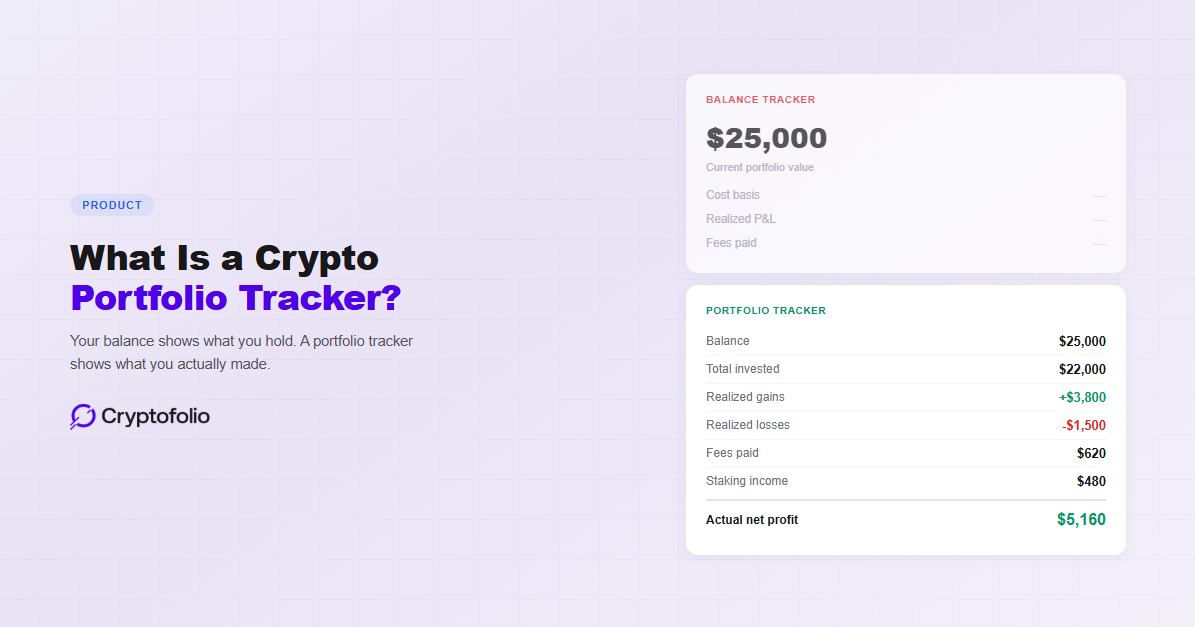
Say your portfolio balance shows $25,000. That is one number. It tells you the current value of your holdings. Now consider what a portfolio tracker shows for the same portfolio:
The balance screen tells you $25,000. The portfolio tracker tells you $5,160 in actual net profit. These are two completely different pieces of information. The balance is the market value of what you hold right now. The profit is what you actually made across everything you did, including trades that already closed, fees you already paid, and income you already earned.
Without cost basis, you cannot calculate your profit. Without profit, you cannot make informed decisions about selling, rebalancing, or harvesting losses. And without accurate records of all of the above, you cannot file your taxes correctly. For the step-by-step filing walkthrough, see our filing guide.
Some tools try to work around this by starting to track from the moment you connect your wallet. Whatever the market price is on day one of connection becomes your "cost basis." This is wrong. If you bought ETH at $1,200 in 2023 and connected your wallet when ETH was $3,500 in 2025, that tracker thinks your cost basis is $3,500. If ETH drops to $3,000, it shows you down $500 when you are actually up $1,800. If you sell at $3,000, it reports a loss when you have a real taxable gain of $1,800.
The numbers are not just inaccurate. They point in the wrong direction. A real portfolio tracker imports your full transaction history back to when each wallet was created, so your cost basis reflects what you actually paid, not what the market happened to be doing on the day you signed up.
Three Types of Tools (And What They Actually Do)
The crypto market has three categories of tools that get grouped together but serve very different purposes.
Balance trackers show what you hold and what it is worth. CoinGecko, CoinMarketCap, DeBank, and Zerion fall into this category. They pull your wallet balances and show current values, token allocations, and sometimes DeFi positions. They do not track cost basis, calculate P&L, or maintain transaction history in a way that supports tax reporting. For a detailed breakdown of what balance trackers miss and how to tell if your current tool is one, see our balance tracker vs. portfolio tracker comparison.
Answers: “What do I have right now?”
Tax software reconstructs your transaction history at the end of the year and generates tax forms. Koinly, CoinTracker, CoinLedger, and TaxBit are in this category. You connect your accounts during tax season, the software imports your history, and it generates Form 8949. The problem is that retroactive reconstruction is fragile. It relies on complete data from every platform you ever used, and it often breaks on transfers between wallets, DeFi interactions, and edge cases.
Answers: “What do I owe?”
Portfolio trackers maintain a continuous, reconciled record of your holdings, cost basis, P&L, and transaction history in real time. When tax season arrives, the data is already accurate because it was maintained continuously, not reconstructed after the fact. The tax output is a byproduct of accurate portfolio tracking, not a separate problem to solve once a year.
Answers: “What did I actually make?”
The distinction matters because the approach to data is fundamentally different. Tax software works backward from your current holdings. A portfolio tracker works forward from your first transaction. The forward approach catches errors, missing data, and broken cost basis chains as they happen, not months later when you are trying to file.
For a detailed comparison of where Koinly and CoinTracker fit in the tax software category and how Cryptofolio differs as a portfolio tracker, see our Koinly vs CoinTracker vs Cryptofolio guide.
For a closer look at what most portfolio apps are not showing you and how the gap between your balance and your real profit works, see our guide on what your portfolio app is not telling you.
What Makes Tracking Crypto Harder Than Stocks
If you own stocks through a single brokerage, your broker tracks your cost basis, calculates your gains, and sends you a 1099-B with everything you need to file. The entire system is built to handle this automatically.
Crypto does not work this way. There are several structural reasons why crypto portfolios are harder to track accurately.
No universal record system. Your crypto might be spread across Coinbase, Kraken, a MetaMask wallet, a Ledger hardware wallet, and three DeFi protocols on two different chains. No single platform can see all of your activity. Each platform only knows about the transactions that happened on its own system. For a complete guide to bringing all of these platforms together without losing your cost basis, see our multi-wallet tracking guide.
Transfers break cost basis. When you move ETH from Coinbase to MetaMask, MetaMask has no idea what you paid on Coinbase. The cost basis trail breaks at every transfer point. Under the IRS's wallet-by-wallet tracking rule (Revenue Procedure 2024-28), each wallet maintains its own lot queue, making transfer tracking even more critical.
DeFi creates complexity. Swapping tokens on Uniswap, staking on Aave, providing liquidity on Curve, bridging between chains. Each of these interactions creates taxable events with their own cost basis calculations. A single yield farming session can generate dozens of separate tax lots. For the full DeFi breakdown, see our DeFi tax guide. For a guide to tracking DeFi positions across multiple protocols and what to look for in a tracker that handles them correctly, see our DeFi tracking guide.
The accounting method you choose changes your tax bill. FIFO, LIFO, and Specific Identification produce different outcomes on the exact same transactions. A portfolio tracker that maintains lot-level data lets you see the impact of each method before you sell, not after.
Broker reporting is incomplete. The new Form 1099-DA reports gross proceeds from centralized exchanges, but for the 2025 tax year, cost basis is not required. DeFi activity, self-custody transactions, staking rewards, and airdrops are not reported at all. The IRS expects you to track and report them yourself.
What to Look for in a Portfolio Tracker
Not all portfolio trackers are built the same. Here is what separates the ones that actually work from the ones that look good on a landing page but fall apart with real data.
Cost basis tracking per wallet. Under current IRS rules, each exchange account and wallet has its own independent lot queue. Your tracker needs to maintain lot-level cost basis at the wallet level, not aggregated across your entire portfolio. If it pools all your Bitcoin into one bucket regardless of where it sits, it is not compliant with the 2025 rules.
Transfer detection and linking. When you send crypto from one platform to another, the tracker needs to recognize it as a transfer (not a sale) and carry the cost basis to the destination. This is the single hardest problem in crypto portfolio tracking, and it is where most tools break.
DeFi transaction parsing. Staking deposits and withdrawals, LP entries and exits, token swaps, bridge transfers, and airdrops each require different cost basis treatment. A tracker that classifies an Aave deposit as a "transfer to unknown address" is not parsing DeFi correctly.
Fee tracking as first-class data. Gas fees and exchange fees need to be captured in the same system as trades and transfers. Gas fees are separate taxable dispositions. Exchange fees adjust cost basis. If fees are treated as footnotes or ignored, your P&L will not hold up to review.
Real-time data, not annual reconstruction. A tracker that imports your history once a year and tries to piece it together retroactively will always be less accurate than one that processes transactions as they happen. Real-time tracking catches errors, flags missing data, and keeps your records current.
Read-only access. A portfolio tracker should never need your private keys, withdrawal permissions, or custody of your assets. Read-only API connections and public wallet addresses are all that is required. If a tool asks for more, it is asking for too much.
For a detailed guide on what to look for when choosing a portfolio tracker, see our buyer's guide.
Where Cryptofolio Fits
Cryptofolio is a portfolio tracker. Not a balance aggregator. Not tax software. For a full product overview covering how Cryptofolio works, what it tracks, and where it sits relative to balance trackers and tax tools, see the Cryptofolio overview.
It connects to your exchanges and wallets with read-only access, imports your complete transaction history back to the creation date of each wallet, and maintains a reconciled ledger across every connected account. Cost basis is tracked per lot, per wallet, in real time. When you sell, the system applies your chosen accounting method automatically against the correct wallet's lot queue.
Staking rewards, airdrops, DeFi interactions, bridge transfers, and gas fees are all parsed and classified. When a protocol interaction cannot be fully resolved automatically, Cryptofolio flags it for your review rather than silently guessing. You can also manually link related transactions for edge cases that automation cannot handle.
The result: when you want to know what you actually made, the answer is already there. When tax season arrives, the numbers are already calculated. You are not scrambling to reconstruct a year of activity across five platforms in April.
Your balance tells you what you have. Your cost basis tells you what you made.
Cryptofolio tracks both across every wallet, exchange, and chain, so you always know your real position.
The Bottom Line
A crypto portfolio tracker is not a nice-to-have. For anyone with holdings across multiple platforms, DeFi activity, or any level of trading beyond buy-and-hold on a single exchange, it is the difference between knowing your real financial position and guessing.
Balance trackers show what you hold. Tax software tries to reconstruct what happened. A portfolio tracker maintains an accurate, continuous record of what you paid, what you earned, what you lost, and what you owe every day, not just at tax time.
The regulatory environment is getting clearer. The SEC just classified most crypto assets into defined categories. The IRS requires wallet-by-wallet cost basis tracking. Exchanges are reporting your proceeds on Form 1099-DA. The infrastructure around crypto is maturing rapidly.
Your tracking should keep pace.
For a practical guide on how to track your portfolio the right way, including what to connect across wallets, exchanges, and chains, and how to verify your numbers are accurate, see our tracking walkthrough.
Disclaimer: This article is for informational purposes only and does not constitute legal, tax, financial, or investment advice. Consult a qualified professional for advice on your individual circumstances.