Koinly vs CoinTracker vs Cryptofolio: What's the Difference?
Koinly and CoinTracker are tax software. Cryptofolio is a portfolio tracker. Here's what each one does, where they fall short, and how to decide which one you need.
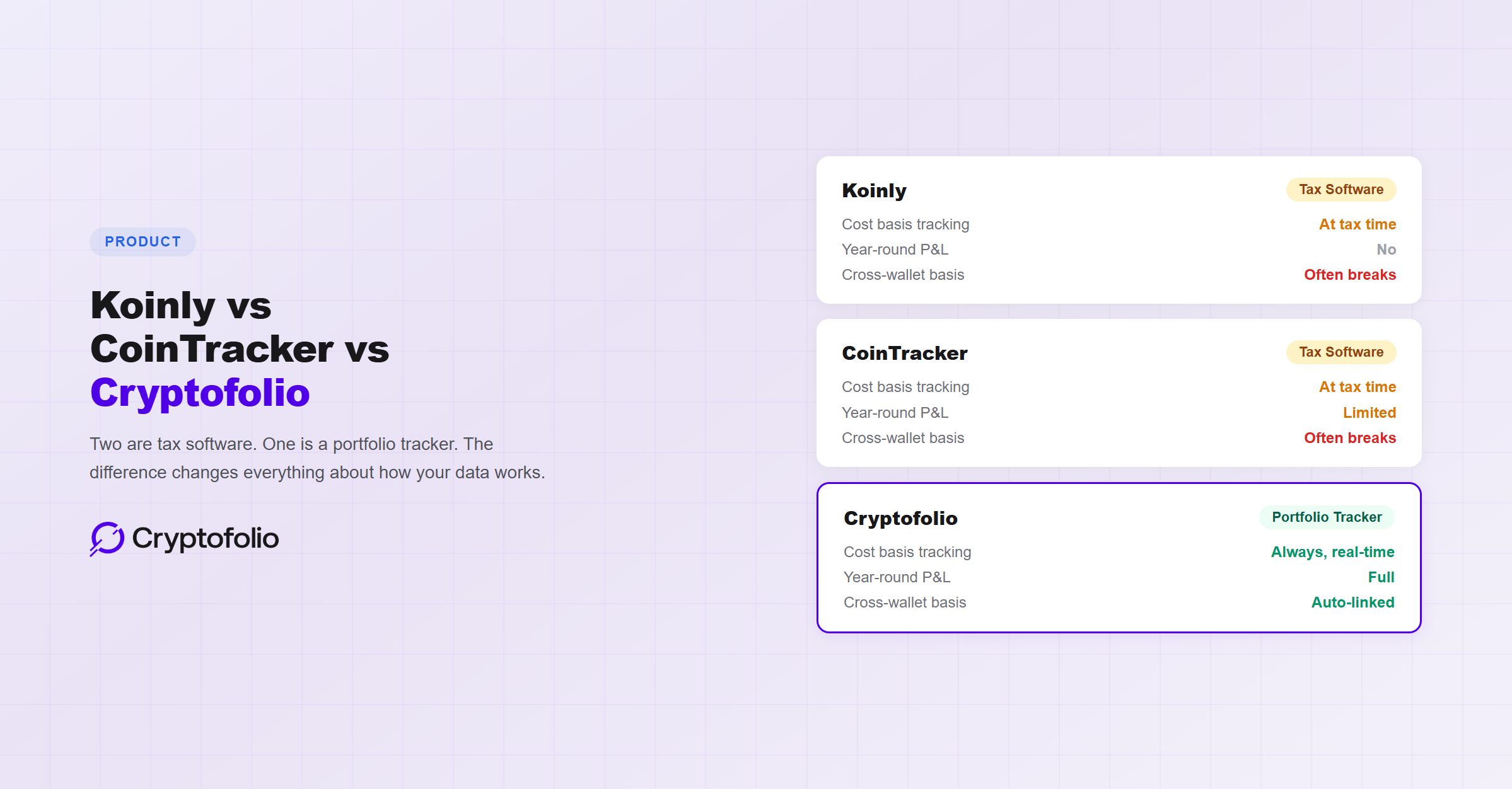
If you search for “crypto tax software,” Koinly and CoinTracker are the first two names you will find. They have millions of users combined, partnerships with major exchanges, and years of brand recognition during tax season.
Cryptofolio is neither of those things. It is not tax software. It is a portfolio tracker that happens to produce tax-ready output because it tracks your data accurately all year.
That distinction sounds small. It changes everything about how the three tools work, when you use them, and what they get right or wrong.
What Each Tool Is Designed to Do
The easiest way to understand the difference is to look at what each product was built for.
Koinly is crypto tax software. You connect your exchanges and wallets, Koinly imports your transaction history, calculates your capital gains and income, and generates tax reports (Form 8949, Schedule D, and country-specific formats for 100+ jurisdictions). Koinly has over 1 million users and partners with exchanges like Coinbase and Kraken for distribution. The product exists to answer one question at one time of year: how much do I owe in taxes?
CoinTracker is also crypto tax software, with a portfolio tracking layer built on top. It follows a similar workflow: import transactions, calculate cost basis and gains, generate tax forms. CoinTracker has built specific workflows around 1099-DA reconciliation, and it partners with Coinbase as their recommended tax solution. CoinTracker claims over 3 million users. Like Koinly, the primary use case is annual tax filing.
Cryptofolio is a portfolio tracker. It connects to your exchanges and wallets, imports your full transaction history back to when each wallet was created, and maintains accurate cost basis in real time across every asset, wallet, and chain. You use it year-round to see your real P&L, not just your balance. When tax season arrives, the data is already accurate because it was never allowed to break in the first place. Tax-ready output is a byproduct of continuous tracking, not the starting point.
The Core Difference: Reconstruction vs. Continuous Tracking
Koinly and CoinTracker both reconstruct your financial history after the fact. You connect your accounts in March or April, the software pulls your transaction data, and it attempts to piece together what happened over the past year (or longer). It calculates your cost basis retroactively, matches transfers between platforms, classifies each transaction, and produces a tax report.
This works well for straightforward cases. If you bought Bitcoin on Coinbase and sold it on Coinbase, both tools will get the numbers right.
It starts to break when your crypto has moved. If you transferred ETH from Coinbase to MetaMask, bridged it to Arbitrum, swapped half for USDC on Uniswap, staked the rest on Aave, and later withdrew and sold on Kraken, the reconstruction has to trace that entire path and carry the original cost basis through every step. Each hop is a potential break point. Each protocol interaction needs to be classified correctly. Each gas fee needs to be captured.
Retroactive reconstruction is fundamentally a patching exercise. The software is trying to figure out what happened after it already happened. The longer the gap between when transactions occur and when they are processed, the more likely something gets misclassified, missed, or assigned the wrong cost basis. For a detailed look at the five specific ways this produces wrong P&L numbers, see our P&L tracker guide.
Continuous tracking takes a different approach. Instead of reconstructing the past, it maintains a live ledger that updates as transactions happen. Cost basis is assigned when you acquire an asset. It follows the asset through transfers, DeFi interactions, and chain hops in real time. When you sell, the gain or loss is already calculated because the system never lost track of the basis.
This is the structural difference between Cryptofolio and the tax tools. Not a feature gap. An architectural one.
Where Koinly Falls Short
Koinly is a strong product for what it is designed to do. It supports 800+ integrations, handles DeFi and NFT transactions, and produces localized tax reports for over 100 countries. For users with simple portfolios on major exchanges, it works well.
The problems show up with complexity.
CEX imports frequently misclassify transactions. User complaints about Bybit and Binance imports are recurring. Purchases get classified as transfers. Cashback rewards get miscategorized. The result is incorrect gain calculations that require manual correction. For users with thousands of transactions, reviewing each one is not practical.
DeFi and perpetuals require manual fixes. Despite supporting DeFi protocols, complex interactions like perpetual futures, LP positions, and advanced staking often need manual intervention. Koinly can import the transactions, but the classification is not always correct. Users report spending hours fixing DeFi-related entries.
Transaction-based pricing creates unexpected costs. Koinly's paid plans are tiered by transaction count per tax year: $49 for 100 transactions, $99 for 3,000, $179 for 10,000, and additional transactions available beyond that. UTXO chains like Bitcoin can inflate transaction counts because the underlying blockchain mechanics generate many small entries. DeFi activity does the same. Users who expect to be on the $99 plan often discover they need the $279 plan after importing their data.
It is a once-a-year tool. Koinly's free plan lets you import transactions and preview your tax summary, but you pay to download the actual reports. The workflow is designed around tax season. You connect, import, fix, pay, download, and close until next year. There is no year-round P&L tracking, no real-time portfolio analytics, and no ongoing value between filing deadlines.
(For more on how cost basis breaks when you move crypto between platforms, see our transfer guide. For a detailed look at how trading bots expose transaction volume limitations and lot-level tracking requirements, see our trading bot tax guide.)
Where CoinTracker Falls Short
CoinTracker shares many of the same strengths and weaknesses as Koinly, with a few distinctions.
Import accuracy is the most common complaint. CEX and wallet imports miss trades, create duplicates, or miscategorize transfers. This is the same fundamental problem as Koinly: retroactive reconstruction depends on clean imports, and the imports are not always clean.
NFT transfers between personal wallets are treated as taxable events. Moving an NFT from one wallet you own to another wallet you own is not a taxable event. CoinTracker has historically misclassified these as disposals, generating phantom gains that inflate your tax liability.
DeFi and chain coverage has persistent gaps. Popular wallets and DeFi protocols still lack full support. Users with activity on newer chains or niche protocols report missing or incorrect data.
Pricing scales steeply for active users. CoinTracker's plans range from $29 (100 transactions) to $1,999 (250,000 transactions). The Ultra plan at $599 covers 10,000 transactions. Features like tax-loss harvesting and the ability to change cost basis methods by year are locked behind the Ultra tier. For active DeFi users, costs add up quickly.
Year-round tracking is secondary. CoinTracker does offer portfolio tracking in its dashboard, and it has improved its real-time features over time. But the core product and pricing are structured around annual tax reporting. The portfolio view exists to support the tax workflow, not as a standalone product.
What Cryptofolio Does Differently
Cryptofolio is not trying to be better tax software. It is a different kind of tool. For a full product overview of what Cryptofolio does and how it works, including the nine specific capabilities that separate it from both balance trackers and tax software, see the Cryptofolio product overview.
Year-round P&L, not annual reconstruction. Your net worth, cost basis, realized gains, unrealized gains, fee totals, and income are updated continuously. You do not wait until April to discover what you owe. You know your tax position at any point during the year, which lets you make informed decisions about selling, harvesting losses, and rebalancing. (For more on tax-loss harvesting strategy, see our harvesting guide.)
Historical import from wallet creation. When you connect a wallet, Cryptofolio imports your entire on-chain history back to the day that wallet was created. It does not start tracking from the day you sign up. This is critical for cost basis accuracy. If tracking starts from connection, every prior acquisition has unknown cost basis. Cryptofolio avoids this by pulling the complete history, which is what makes the cost basis figures trustworthy from day one.
Cost basis that follows your crypto everywhere. When you transfer ETH from Coinbase to MetaMask, the cost basis follows. When you deposit into Aave, the basis carries into the position. When you withdraw and bridge to another chain, the basis comes with it. For edge cases where automation cannot resolve the link, the review flow lets you manually bind send and receive transactions to carry cost basis across platforms. No competitor supports this level of transaction linking. (For the full explanation of how transfers break cost basis and how to fix it, see our cost basis guide.)
Protocol-level DeFi tracking. Each supported DeFi protocol gets its own parsing logic. An Aave deposit is classified as a lending position, not a transfer to an unknown address. A Uniswap LP entry is classified as a liquidity provision event, not a sale. Staking rewards are recorded as income at fair market value when claimed. This transaction-level intelligence is what produces accurate P&L on DeFi activity. (For more on DeFi tracking challenges, see our DeFi tracking guide.)
Gas and exchange fees as first-class data. Every gas fee is tracked as a taxable disposal of the native token, running through your wallet's FIFO lot queue. Exchange fees adjust your cost basis. These are not footnotes or approximations. They are real line items in your P&L that can add up to thousands of dollars for active users.
Per-wallet cost basis tracking. Under Revenue Procedure 2024-28, the IRS requires wallet-by-wallet cost basis tracking starting January 1, 2025. Cryptofolio tracks at this level natively. Each exchange account and each wallet maintains its own independent FIFO lot queue. When you sell from Kraken, only lots held on Kraken are consumed. (For the full explanation of the wallet-by-wallet rule and accounting methods, see our FIFO vs. LIFO guide.)
Unsupported protocols are flagged, not ignored. When Cryptofolio encounters a protocol it does not yet support, the transaction is flagged in the UI for your review. You can classify it manually and enter cost basis. When the protocol is added (typically within 12 to 24 hours of the request), the on-chain data replaces your manual entry automatically. This is the difference between wrong data and honest data.
Side-by-Side Comparison
Here is how the three tools compare across the factors that matter most.
| Koinly | CoinTracker | Cryptofolio | |
|---|---|---|---|
| Primary purpose | Tax reporting | Tax reporting | Portfolio tracking |
| When you use it | Tax season | Tax season | Year-round |
| Cost basis approach | Retroactive reconstruction | Retroactive reconstruction | Continuous, real-time |
| Historical import | From connection date | From connection date | From wallet creation date |
| Year-round P&L | No (tax summary only) | Limited dashboard | Full: realized, unrealized, income, fees |
| Per-wallet FIFO queues | Sometimes | Sometimes | Yes, IRS-compliant |
| DeFi classification | Supports many, manual fixes common | Supports many, gaps on newer chains | Protocol-specific parsing logic |
| Gas fee tracking | Footnote | Included in calculations | First-class ledger data |
| Cross-wallet cost basis | Often breaks on transfer | Often breaks on transfer | Automatic linking + manual binding for edge cases |
| Unsupported protocol handling | Error or guess | Error or gap | Flagged for review, auto-replaced when added |
| Tax report generation | Core feature | Core feature | Coming soon |
| Pricing model | Per transaction, per year ($49 to $179+) | Per transaction, per year ($29 to $1,999) | Free basic tier, premium for advanced features |
Which One Do You Need?
The answer depends on what problem you are trying to solve.
If your only goal is filing your taxes and your portfolio is mostly on centralized exchanges, Koinly or CoinTracker will work. They are mature products with broad exchange support and established filing workflows. Connect in March, generate your reports, file, and move on.
If you use DeFi, move crypto between wallets, or want to know your real P&L at any point during the year, the tax tools will struggle. They are designed to reconstruct your history once a year, not maintain it continuously. The more complex your activity, the more manual work you will do fixing misclassified transactions, broken transfers, and incorrect cost basis.
If you want a tool that tracks your portfolio accurately all year and produces tax-ready output as a natural consequence of that accuracy, that is what Cryptofolio is built for. You do not connect once a year to generate a report. You connect once, and the data stays accurate from that point forward.
The question is not which tax software is better. The question is whether tax software is the right category for what you need.
For a framework to evaluate any crypto portfolio tool across the six criteria that separate real trackers from balance viewers, see our portfolio tracker buyer's guide. For a more detailed look at what each tool's free tier actually includes, see our breakdown of what free crypto portfolio trackers actually include. For a closer look at how CoinStats and DeBank compare on the same dimensions, see our CoinStats and DeBank comparison.
Your portfolio is more than a tax form. Track it like it.
Cryptofolio maintains accurate cost basis across every wallet, exchange, and DeFi protocol, all year. Tax-ready output is a byproduct of that accuracy.
The Bottom Line
Koinly and CoinTracker are good at what they do. They are tax tools built for an annual workflow: connect, import, calculate, file. For simple portfolios on major exchanges, they work.
Cryptofolio solves a different problem. It is a portfolio tracker that maintains your financial records continuously so they never need to be reconstructed. The tax output falls out of accurate tracking. The year-round P&L, real-time cost basis, DeFi position tracking, and fee accounting are what make the tax numbers correct in the first place.
If you have been using Koinly or CoinTracker and spend hours every April fixing broken imports and misclassified transfers, that is not a bug in those products. That is the limitation of retroactive reconstruction. The alternative is a system that never loses the trail.
Disclaimer: This article is for informational purposes only and does not constitute legal, tax, financial, or investment advice. Product features and pricing described are accurate as of March 2026 and may change. Consult a qualified professional for advice on your individual circumstances.