What Is Cryptofolio and How Does It Work?
Cryptofolio is a crypto portfolio tracker that maintains cost basis per lot, per wallet, across every chain. Here's how it works, what it tracks, and why it's different from balance trackers and tax tools.
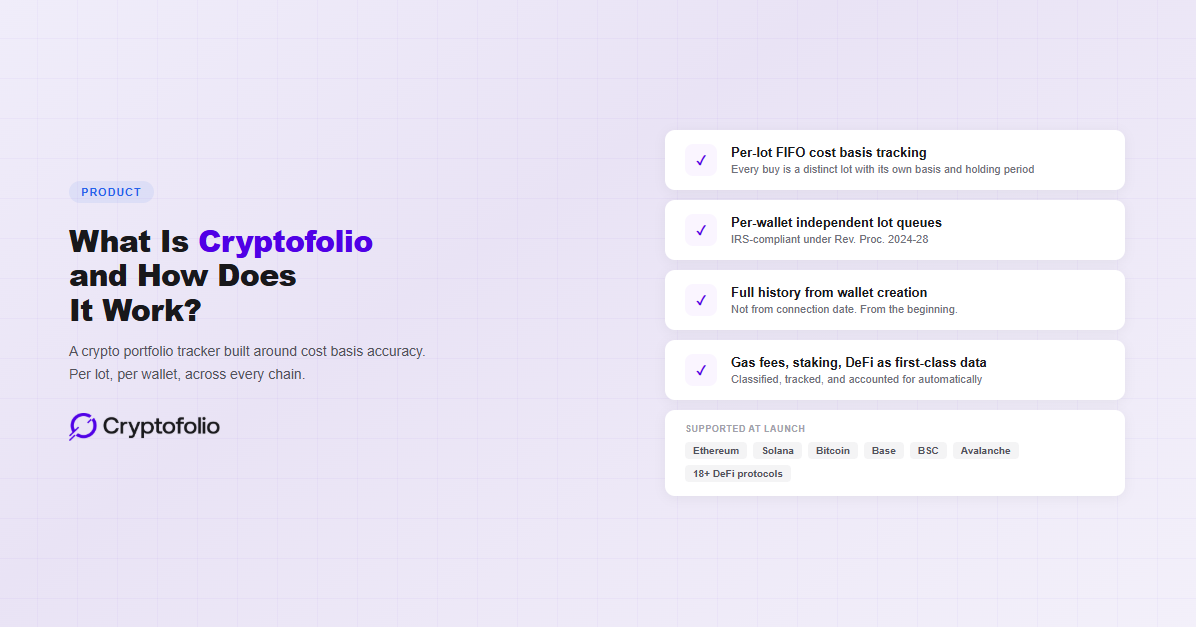
Cryptofolio is a crypto portfolio tracker built around cost basis accuracy. It connects to your wallets and exchanges, imports your complete transaction history back to wallet creation, and maintains a per-lot, per-wallet ledger that updates with every new trade, transfer, bridge, staking reward, and gas fee.
The result: your P&L is always current, always based on what you actually paid, and always scoped to each wallet independently. Tax-ready output is a byproduct of that accuracy, not a separate problem solved once a year.
This post explains what Cryptofolio does, how it works, and where it fits relative to balance trackers and tax software.
The Problem Cryptofolio Solves
Most crypto holders don't know their actual profit. They know their balance. Their tracker shows them what their crypto is worth right now. It does not show them what they paid for it, what they've spent in fees, or how transfers between wallets affected their cost basis.
The gap between balance and profit is cost basis. If you bought ETH at $1,800 and it's now worth $3,000, a balance tracker shows $3,000. But if you bought it across six transactions at six different prices, bridged it twice, paid gas fees on 40 DeFi interactions, and staked it through two protocols, your actual profit depends on which lots you sold, what the gas fees consumed, and whether the staking rewards were recorded as income at the correct FMV.
No balance tracker answers that question. Tax software tries to answer it once a year by reconstructing your history after the fact. Cryptofolio answers it continuously by maintaining the ledger in real time. For a full breakdown of why your balance and your profit are different numbers and what it takes to calculate your actual return, see our guide on how much you really made in crypto. For a broader look at what separates balance trackers from tools that actually track your portfolio, see our guide on crypto balance trackers vs. portfolio trackers.
How Cryptofolio Works
When you connect a wallet or exchange, Cryptofolio imports your entire on-chain transaction history back to the wallet's creation date. Not from the day you connect. From the beginning.
Every transaction is classified: buys, sells, swaps, transfers, bridges, staking rewards, lending interest, airdrops, gas fees, exchange fees. Each one updates a reconciled ledger that tracks cost basis per lot, per wallet.
The classification matters because different transaction types have different accounting implications. A swap is a disposal of one asset and an acquisition of another. A transfer between your own wallets is not a taxable event, but the cost basis needs to follow. A staking reward is ordinary income at fair market value at the time of receipt, and it creates a new lot in your FIFO queue. A gas fee is a separate disposal of the fee asset. Cryptofolio handles each of these according to its specific rules rather than applying a generic balance-diff calculation. For a full explanation of how FIFO lot ordering works under current IRS rules, see our FIFO vs. LIFO guide.
What Makes It Different
There are dozens of crypto portfolio trackers. They fall into two categories: balance trackers and tax tools. Cryptofolio is neither.
Balance trackers like CoinStats, DeBank, and Zerion connect your accounts and show your current holdings. Some offer P&L at the aggregate level. None maintain per-lot cost basis with FIFO ordering, per-wallet isolation, or gas fee tracking as separate disposals. They are built to show you what you hold, not what you made.
Tax tools like Koinly, CoinTracker, and CoinLedger reconstruct your cost basis once a year at filing time. They import your history, attempt to classify transactions, and produce tax forms. The reconstruction is retroactive, which means errors from misclassified transfers or missing data can silently cascade through your entire history.
Cryptofolio sits between these two categories. It provides the year-round portfolio dashboard that balance trackers offer, but built on a cost basis engine that maintains per-lot accuracy continuously. The tax-ready output that tax tools charge for annually is a natural byproduct of the accurate ledger Cryptofolio maintains every day.
Nine things Cryptofolio does that most competitors don't:
1. Per-lot cost basis tracking with FIFO ordering across every wallet and exchange. Each purchase creates a distinct lot with its own acquisition date, cost basis, and holding period.
2. Per-wallet FIFO queues as required by Rev. Proc. 2024-28. Each wallet has its own independent lot queue. Selling from one wallet consumes the oldest lots in that wallet, not the oldest lots across your portfolio.
3. Historical import from wallet creation. When you connect, Cryptofolio pulls your complete on-chain history. No synthetic fill transactions. No gaps.
4. Gas fee tracking as first-class ledger data. Every gas fee is a taxable disposal that consumes a lot from your FIFO queue with its own gain or loss calculation. Most trackers ignore this entirely.
5. Income classification for staking rewards, lending interest, and airdrops at FMV at the time of receipt. Each creates a new tax lot in the receiving wallet. For a detailed look at how staking rewards create new lots across wallets, see our guide on tracking crypto staking rewards across wallets.
6. DeFi protocol decoding. Aave aToken increments, Uniswap v3 NFT positions, Lido stETH rebases, Curve gauge emissions. Each protocol has its own smart contract architecture, and Cryptofolio interprets each one according to its on-chain behavior.
7. Unsupported protocol handling. If a protocol is not supported yet, the transaction is flagged for manual review. Once support is added, the manual entry is automatically replaced with verified on-chain data.
8. Historical portfolio reconstruction at any date. The treemap shows your portfolio composition at any point in time, resolving positions in protocols that may no longer exist.
9. CSV exports filtered by any combination of criteria for accountant handoff.
Supported Chains, Exchanges, and Protocols
Cryptofolio supports Ethereum, Avalanche, Base, BSC, Solana, and Bitcoin, with additional chains on the roadmap.
Exchanges include Binance, Kraken, and Coinbase, with more being added.
Wallet support includes MetaMask, Core, Trust Wallet, Phantom, and WalletConnect.
DeFi protocols include Uniswap (v2, v3, v4), Aave (v2, v3), 1inch, Lido, Curve, Jupiter, Kamino, Raydium, PancakeSwap, EigenLayer, ether.fi, Jito, Babylon, Venus, Morpho, and Aerodrome. The protocol list grows based on what users actually hold. If you have activity on an unsupported protocol, Cryptofolio flags it so nothing is silently ignored. For a full explanation of how Cryptofolio handles protocol exploits when a DeFi protocol is hacked or paused, see our DeFi hack guide.
For more on what to look for across chains, exchanges, and protocols when evaluating a tracker, see our guide to choosing the right crypto portfolio tracker.
Your balance shows what you hold. Your ledger shows what you made.
Cryptofolio maintains cost basis per lot, per wallet, across every chain and protocol, updated continuously so the number you see is always accurate.
Security and Privacy
Cryptofolio uses read-only API connections for exchanges and public wallet addresses for on-chain tracking. It never asks for private keys, seed phrases, or withdrawal permissions. It does not custody any user funds.
The platform collects only what is necessary to deliver core functionality: wallet addresses, optional read-only exchange API keys, and limited usage metrics. It does not sell or share user information with third parties. You can disconnect connected accounts at any time.
Sign-up methods include email, X/Twitter, Telegram, Discord, Apple, Google, and crypto wallet. Recovery methods mirror the same options. No personally identifying information is required beyond what you choose to provide.
Pricing
Cryptofolio offers a free Starter tier with basic portfolio tracking. Cost basis, P&L, and advanced features are available on paid tiers. Full pricing details are available at cryptofolio.ai after launch. For a breakdown of what free tiers from major trackers typically include before hitting a paywall, see our guide on the real cost of free crypto portfolio trackers.
Who Cryptofolio Is For
Cryptofolio is built for crypto holders who want to know what they actually made, not just what they hold. If your activity is limited to buying BTC on Coinbase and holding it, a simpler tracker will serve you fine. If you hold crypto across multiple wallets, use DeFi, bridge between chains, or earn staking rewards, you need cost basis tracking that follows your assets through every interaction.
Bridging, in particular, is one of the most common ways cost basis breaks across trackers. For a detailed look at what happens to your basis when you move assets across chains, see our guide on what happens to your cost basis when you bridge crypto.
Product beta spots are closing shortly. You can sign up at cryptofolio.ai. For a step-by-step tracking guide covering what to connect, what to check, and how to verify your numbers across every wallet and chain, see our portfolio tracking walkthrough.
The Bottom Line
Cryptofolio is a portfolio tracker that treats cost basis as a continuous tracking problem, not a tax season emergency. Every trade, transfer, fee, and income event is classified, recorded, and maintained in a per-lot, per-wallet ledger that stays accurate year-round. The P&L you see on your dashboard is the same P&L you would hand to an accountant. Nothing to reconstruct. Nothing to fix.
For a direct comparison of how Cryptofolio differs from Koinly and CoinTracker on the reconstruction versus continuous tracking question, see our Koinly vs. CoinTracker vs. Cryptofolio guide. For a side-by-side look at how CoinStats and DeBank compare on cost basis depth, see our CoinStats vs. DeBank vs. Cryptofolio comparison.
Disclaimer: This article is for informational purposes only and does not constitute legal, tax, financial, or investment advice. Product features and pricing described are accurate as of April 2026 and may change. Consult a qualified professional for advice on your individual circumstances.