How to Choose the Right Crypto Portfolio Tracker
Not all portfolio trackers are the same. Here are the six things that actually matter when choosing one, and how to tell if your current tool measures up.
There are dozens of apps that call themselves crypto portfolio trackers. Most of them show you how much your crypto is worth right now. Some add a chart. A few let you tag transactions. Almost none of them actually track your portfolio.
Tracking a portfolio means knowing what you paid, what you made, what you lost, and what you owe. It means carrying that data across every wallet, exchange, and protocol you have ever used, and keeping it accurate over time. A number on a screen that says “$47,000” tells you your balance. It does not tell you whether you are up or down, what your tax liability is, or whether that Aave position from last year was worth the gas fees.
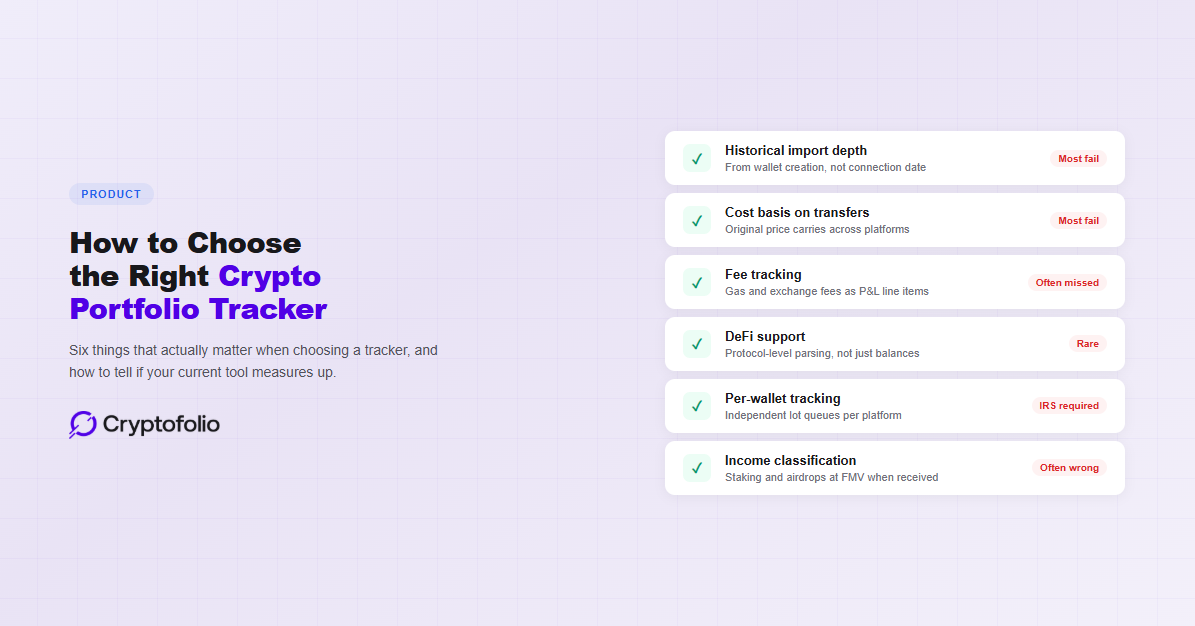
If you are choosing a portfolio tracker in 2026, here are the six things that actually separate a useful tool from a glorified price ticker.
1. How Far Back Does It Import Your History?
This is the single most important question, and the one most people never think to ask.
When you connect a wallet to a portfolio tracker, some tools start recording from that moment forward. They see your current balances and begin tracking price changes from the connection date. Everything that happened before you connected (every purchase, every swap, every transfer, every staking reward) is invisible.
The problem is obvious: if the tracker does not know what you paid for your assets, it cannot calculate your real profit or loss. If you bought ETH at $1,200 in 2023 and connected a tracker in 2025 when ETH was $3,000, the tracker thinks your cost basis is $3,000. Every P&L number from that point forward is wrong.
A tracker worth using imports your full transaction history back to when the wallet was created. Not from when you signed up. Not from your first login. From the first on-chain transaction. That is the only way to establish accurate cost basis for every asset you hold.
This applies to exchange accounts too. When you connect Coinbase or Kraken, the tracker should pull your complete trade history, including purchases, sales, and transfers from the day you opened the account.
When I connect a wallet, does it import from today or from the beginning? If the answer is “from today,” your P&L will be wrong from the start. For more on why this matters, see our P&L guide.
2. Does Cost Basis Survive a Transfer?
You buy 2 ETH on Coinbase for $1,800 each. Total cost basis: $3,600. You send them to MetaMask. You later move them to Kraken and sell.
What does your tracker show as the cost basis when you sell on Kraken?
If the answer is $3,600 (the original purchase price), the tracker correctly linked the transfer and carried the basis forward. If the answer is the fair market value on the day you transferred, or if it shows zero, the tracker lost the trail.
This is the most common point of failure in crypto portfolio tracking. Every transfer between platforms is a potential break in the cost basis chain. Exchange to wallet. Wallet to DeFi protocol. Protocol back to wallet. Wallet to a different exchange. Each hop is a place where the tracker either maintains the connection or loses it.
The best trackers handle this automatically for recognized wallet-to-wallet transfers. For edge cases where automation cannot resolve the link, such as receiving crypto from a peer-to-peer transaction or a rarely used protocol, the tracker should let you manually bind the send and receive transactions to carry basis forward.
What you do not want is a tracker that silently resets your cost basis to zero or fair market value on every transfer without telling you. That produces wrong P&L that looks right on the surface.
If I buy ETH on Coinbase and transfer it to MetaMask, does the original purchase price follow the transfer? Or does the cost basis change after the move? If cost basis resets to fair market value or zero after a transfer, your P&L is wrong on every subsequent sale. For the full breakdown of how transfers break cost basis, see our transfer guide.
3. Are Fees Tracked as Real Costs?
Every crypto transaction has a cost beyond the asset price. Exchange trading fees. Gas fees on every on-chain interaction. Approval fees. Bridge fees. These add up faster than most people realize.
An active DeFi user can easily spend $1,500 to $2,000 per year on gas and exchange fees across chains. That is real money that should reduce your reported profit. If your tracker does not capture these costs, your P&L is overstated by whatever amount you paid in fees.
There is also a tax dimension that most trackers miss entirely. Every gas fee paid in ETH (or AVAX, SOL, or any other native token) is a taxable disposal of that token. If you bought ETH at $1,500 and pay a gas fee when ETH is at $3,000, you have a small capital gain on the ETH consumed by the fee. That gain should run through your FIFO lot queue and appear in your P&L.
Exchange fees are simpler but still matter. When you buy 1 ETH for $3,000 with a $15 exchange fee, your cost basis should be $3,015, not $3,000. Over hundreds of trades, the cumulative difference is significant.
Can I see a total of all gas fees and exchange fees I paid last year as a single line item? If the answer is no, those costs are invisible in your performance numbers. For more on how the IRS treats gas fees, see our cost basis guide.
4. How Does It Handle DeFi?
DeFi positions are fundamentally different from tokens sitting in a wallet. When you deposit ETH into Aave, you receive a rebasing receipt token. When you provide liquidity on Uniswap v3, you get an NFT representing a concentrated range position. When you stake on Lido, your stETH balance rebases daily. Each protocol has its own mechanics, its own yield accrual method, and its own tax implications.
A portfolio tracker that treats DeFi seriously needs protocol-level parsing. An Aave deposit should be classified as a lending position entry, not a transfer to an unknown address. A Uniswap LP deposit should be classified as a liquidity provision event, not a sale. Staking rewards should be recorded as income at fair market value when received, because that is how the IRS treats them under Rev. Rul. 2023-14.
Many trackers support DeFi at the balance level. They can show you that you have 10.3 aETH on Aave or 5.2 stETH on Lido. What they cannot show you is how much income those positions generated, what the cost basis of each reward is, or how the gas fees across dozens of interactions affected your net return.
The other question is what happens when the tracker encounters a protocol it does not support. Does it silently ignore the transaction? Does it misclassify it as a generic transfer? Or does it flag it for your review so you can classify it manually? The difference between these approaches is the difference between wrong data, misleading data, and honest data.
Does it classify each DeFi interaction by type (deposit, withdrawal, reward claim, LP entry), or does it just show balances? If it only shows what you hold without explaining what each interaction means for your P&L, it is a DeFi balance viewer, not a DeFi portfolio tracker. For a deep dive on DeFi tracking challenges, see our DeFi tracking guide.
5. Does It Track Per Wallet?
Starting January 1, 2025, the IRS requires cost basis tracking on a wallet-by-wallet and account-by-account basis under Revenue Procedure 2024-28. This replaced the old “universal wallet” method where you could treat all holdings of the same asset across all platforms as one pool.
What this means in practice: your Coinbase FIFO lot queue is separate from your Kraken FIFO lot queue, which is separate from your MetaMask lot queue. When you sell 1 ETH on Kraken, FIFO should consume the oldest lot held specifically on Kraken, not the oldest lot across all your wallets.
A tracker that pools all your holdings into one global view might show the correct total balance, but the lot queue ordering is wrong. The gain or loss on each sale is calculated against the wrong lots. And the resulting tax output is noncompliant with current IRS requirements.
This matters even if you are not filing taxes this week. Per-wallet tracking builds the correct data foundation. If you ever need to produce tax-ready records, sell a position and want to know the real gain, or hand your data to an accountant, the per-wallet structure is what makes the numbers trustworthy.
If I hold ETH on three different platforms, does each one have its own independent lot queue? Or does it combine everything into one global calculation? For the full explanation of per-wallet requirements and accounting methods, see our FIFO vs. LIFO guide.
6. What Happens With Income Events?
If you stake crypto, earn lending interest, receive an airdrop, or collect liquidity pool fees, those are income events. The IRS treats staking rewards as ordinary income at fair market value when you gain dominion and control (Rev. Rul. 2023-14). Airdrops are taxed similarly under Rev. Rul. 2019-24.
A portfolio tracker needs to do three things with income events.
First, classify them correctly. Staking rewards are ordinary income, not capital gains. The tax rate is different. A tracker that lumps everything together as “gains” is misclassifying the income and producing the wrong tax category.
Second, record the fair market value at the time of receipt. If you received 0.05 ETH in staking rewards when ETH was $2,400, the income is $120 at that moment. Not $150 because ETH is $3,000 now. Not $0 because the tracker did not record it at all. The income is fixed at the moment of receipt.
Third, create a new tax lot for the received asset. That 0.05 ETH has a cost basis of $120 (the FMV at receipt). When you eventually sell it, your capital gain or loss is calculated against that $120 basis. If the tracker does not create this lot, your future sale P&L will be wrong.
Does it classify staking rewards as income or as a gain? Does it record the value at the time received? Does it create a new lot with that value as the cost basis? If any of these are missing, your income tracking and your future P&L are both unreliable. For more on how DeFi income is taxed, see our DeFi tax guide.
The Checklist
Here is a summary of the six evaluation criteria. Run your current tracker against this list.
| Criteria | What to look for | Red flag |
|---|---|---|
| Historical import depth | Imports from wallet creation, not connection date | “Starts tracking when you sign up” |
| Cost basis on transfers | Carries original purchase price across platforms | Basis resets to FMV or $0 after transfer |
| Fee tracking | Gas and exchange fees as line items in P&L | Fees not visible in performance breakdown |
| DeFi support | Protocol-level parsing with correct classification | Only shows DeFi balances, no P&L |
| Per-wallet tracking | Independent lot queues per wallet and exchange | One global queue across all platforms |
| Income classification | Staking/airdrops classified as income at FMV when received | Lumped in as “gains” or not recorded |
If your current tool fails on even one of these, the headline number on your dashboard is not your real P&L. It is an estimate built on incomplete data. For a step-by-step guide on what real tracking requires, including what to connect, what to verify, and how to identify gaps in your setup, see our tracking guide.
Your portfolio tracker should answer one question: how much did you actually make?
Cryptofolio is built around getting that answer right. Full history import, cost basis that survives every transfer, fees as first-class data, protocol-level DeFi tracking, per-wallet lot queues, and proper income classification.
The Bottom Line
The crypto portfolio tracker market is crowded, but most of the products in it are solving the wrong problem. They show you what your crypto is worth today. That is the easy part. The hard part is knowing what you paid, what you made, what each position cost you in fees, and what you owe in taxes. That requires historical import depth, cost basis continuity, fee tracking, DeFi parsing, per-wallet compliance, and income classification working together.
No single feature on this list is enough on its own. A tracker can import full history but still break cost basis on transfers. It can track fees but miss DeFi income. It can support per-wallet queues but start from the connection date. The value is in all six working correctly at the same time.
If your current tool cannot tell you the original cost basis of a transferred asset, the total fees you paid last year, or the income you earned from staking, it is not tracking your portfolio. It is watching your balance. Those are not the same thing.
For a full product overview of what Cryptofolio does differently from both balance trackers and tax tools, including the nine specific things it does that most competitors don't, see the Cryptofolio product overview.
For a direct comparison of how specific tools measure up, see our Koinly vs CoinTracker vs Cryptofolio guide. For a look at how CoinStats and DeBank specifically compare on cost basis tracking, see our CoinStats and DeBank comparison. For a broader look at the difference between balance trackers and portfolio trackers, see our comparison guide. For a breakdown of what free tiers from popular trackers actually include before any paid features kick in, see our guide on what free crypto portfolio trackers actually include. For what to verify before connecting your accounts, including what API permissions and data collection each tracker requires, see our guide on crypto tracker security.
Disclaimer: This article is for informational purposes only and does not constitute legal, tax, financial, or investment advice. Cryptocurrency tax rules are complex, depend on your specific situation, and are subject to frequent regulatory changes. While we strive to keep our content accurate and up to date, information in this article may become outdated as policies evolve. Consult a qualified professional for advice on your individual circumstances.