Why Your Crypto P&L Is Wrong (And How to Fix It)
Most crypto P&L numbers are wrong. Here are the five most common reasons your profit and loss calculations are off, and what it takes to fix them.
Open your portfolio tracker. Look at the P&L number. Now ask yourself: do you trust it?
If you have ever transferred crypto between wallets, earned staking rewards, paid gas fees on DeFi transactions, or moved assets across chains, there is a good chance that number is wrong. Not because the math is broken, but because the data going into the math is incomplete.
Crypto P&L looks simple on the surface. You bought something for one price and it is now worth another price. The difference is your profit or loss. But that calculation depends on knowing exactly what you paid for every asset you hold, and for most people with active crypto portfolios, that number is either missing, approximate, or flat-out incorrect.
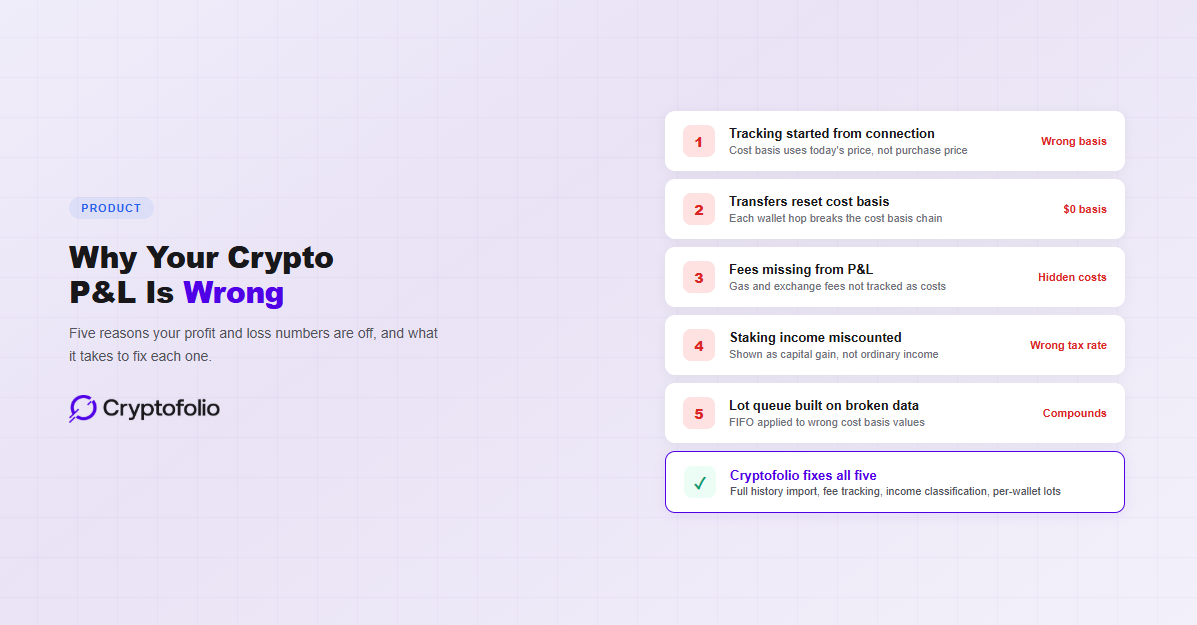
Here are the five most common reasons your crypto P&L is wrong, and what it takes to fix each one.
1. Your Tracker Started From the Day You Connected, Not the Day You Bought
This is the most common source of inaccurate P&L, and most people do not even realize it is happening.
When you connect a wallet to a portfolio tracker, many tools start tracking from that moment forward. They see your current balances and begin recording price changes from the connection date. Any activity that happened before you connected (every purchase, every swap, every transfer) is invisible to the tracker.
The result is that your cost basis is wrong from the start. If you bought ETH at $1,200 in 2023 but connected your wallet in 2025 when ETH was at $3,000, a start-from-connection tracker treats $3,000 as your cost. If ETH rises to $3,500 and you sell, the tracker shows a $500 gain. Your actual gain is $2,300. Your P&L is understated by $1,800.
This also works in the other direction. If you bought at $4,000 and connected when the price was $2,500, the tracker overstates your loss because it thinks you paid $2,500, not $4,000.
The fix is straightforward but uncommon: the tracker needs to import your full transaction history back to when the wallet was created. Not from when you signed up. Not from your first login. From the first on-chain transaction. That is the only way to establish accurate cost basis for every asset you hold.
Cryptofolio imports your entire on-chain history back to wallet creation. When you connect a wallet, every past transaction is pulled and processed so that cost basis is correct from day one. (For more on why cost basis accuracy matters, see our cost basis guide.)
2. Transfers Between Wallets Reset Your Cost Basis
You buy 2 ETH on Coinbase at $1,800 each. You send them to your MetaMask wallet. Your total cost basis is $3,600.
From MetaMask's perspective, 2 ETH appeared. It has no idea where they came from or what you paid. If your tracker does not recognize this as a self-transfer and link the incoming transaction to the outgoing one on Coinbase, one of two things happens: either the cost basis resets to fair market value on the day of the transfer, or the cost basis is marked as unknown (effectively zero).
Both outcomes produce wrong P&L. A cost basis reset means your gains and losses are calculated from the wrong starting point. A zero cost basis means the IRS treats the entire sale proceeds as profit.
This problem multiplies with every additional transfer. Coinbase to MetaMask. MetaMask to Arbitrum via a bridge. Arbitrum back to Ethereum. Ethereum to Kraken. Each hop is a point where cost basis can break, and most tools break it at least once in that chain.
The fix requires the tracker to identify transfers between your own wallets, link the send and receive transactions, and carry the original cost basis forward. For cases where automation cannot resolve the link, you need the ability to manually bind the transactions yourself.
Cryptofolio handles this automatically for recognized wallet-to-wallet transfers and provides a manual binding flow for edge cases. When the system cannot determine that two transactions are linked, it flags them for your review instead of guessing or resetting to zero. (For a full breakdown of how transfers break cost basis and how to fix it, see our transfer guide. For the specific challenges that arise when bridging between chains, including wrapped tokens and cross-chain fee tracking, see our bridge cost basis guide.)
3. Gas Fees and Exchange Fees Are Missing From Your P&L
Every on-chain transaction costs gas. Every exchange trade includes a fee. These are real costs that directly reduce your profit, but many trackers either ignore them entirely or treat them as a footnote outside the P&L calculation.
The impact is larger than most people expect. Gas fees on Ethereum have dropped dramatically since the Dencun upgrade in 2024, with simple transfers now costing under $1 and complex DeFi interactions averaging $1 to $3 on mainnet. But they still add up. An active DeFi user making 15 to 20 transactions per week across Ethereum and other chains can easily spend $1,500 to $2,000 per year on gas alone, more during congestion spikes. Add in exchange trading fees across hundreds of trades and the total fee burden can reach several thousand dollars. That is real cost that should be reflected in your P&L but often is not.
There is also a tax dimension. Each gas fee paid in ETH is a taxable disposal of ETH. If you bought ETH at $1,500 and pay a gas fee when ETH is at $3,000, you have a realized capital gain on the amount of ETH consumed by the fee. That gain (or loss) should run through your FIFO lot queue and appear in your P&L. Most trackers do not do this.
Exchange fees are simpler but still frequently mishandled. When you buy 1 ETH for $3,000 with a $15 exchange fee, your cost basis should be $3,015, not $3,000. When you sell, that $15 reduces your taxable gain. Over hundreds of transactions, the cumulative impact of exchange fees on your P&L can be substantial.
Cryptofolio tracks gas fees as first-class ledger data. Each gas payment runs through your wallet's FIFO lot queue for the native token, and the resulting gain or loss is included in your P&L. Exchange fees are added to cost basis on purchases and subtracted from proceeds on sales. (For a full breakdown of why gas fees are taxable disposals, how they affect your FIFO queue, and what correct gas tracking looks like, see our gas fees cost basis guide. For more on how the IRS treats fees more broadly, see our cost basis guide and our tax filing guide. For a look at how fee tracking breaks down when bots execute thousands of trades per month, see our trading bot tax guide.)
4. Staking and Lending Income Is Not Counted (or Counted Wrong)
If you stake ETH on Lido, earn yield on Aave, or collect rewards from a liquidity pool, that income needs to appear in your P&L. The IRS treats staking rewards and lending interest as ordinary income at fair market value when you gain dominion and control (Rev. Rul. 2023-14 for staking rewards). It is not a capital gain. It is income, taxed at your ordinary income rate.
Many portfolio trackers do not track this at all. They show your balance going up as rewards accrue, but they do not recognize the income event or record the fair market value at the time of receipt. Your P&L looks like a capital gain when it is actually income, and the amount may be wrong because the tracker is using the current price rather than the price at the time each reward was received.
Here is a concrete example. You stake 10 ETH on Lido and earn 0.3 ETH in staking rewards over six months while ETH goes from $2,000 to $3,000. A tracker that does not properly classify staking income might show that 0.3 ETH as an unrealized gain of $900 (0.3 times $3,000 at the current price). The actual income is roughly $750, recognized incrementally at the fair market value on each date the rewards accrued. The difference is not just a number.
It changes your tax category (income vs. capital gains) and your tax rate.
Each staking reward also creates a new tax lot with its own cost basis (the fair market value at the time of receipt). When you eventually sell that 0.3 ETH, you need to calculate capital gain or loss against that basis. If your tracker does not create these lots, your future sale P&L will also be wrong.
Cryptofolio classifies staking rewards, lending interest, and DeFi yield as income at fair market value when received. Each income event creates a new tax lot with the correct cost basis for future sale calculations. (For more on how DeFi income is taxed, see our DeFi tax guide. For a step-by-step look at how staking rebases, lending deposits, and withdrawals each change your cost basis, see our DeFi cost basis guide. For details on how staking positions are tracked across protocols, see our DeFi tracking guide. For a detailed look at how airdrops are classified as income and what cost basis to record at receipt, see our airdrop tax guide.)
5. Your Accounting Method Does Not Match Your Lot Queue
When you sell crypto, the gain or loss depends on which specific lots you are selling. If you bought 1 ETH at $1,500 in January and 1 ETH at $3,500 in June, and you sell 1 ETH in October, your gain depends entirely on which lot is consumed by the sale.
Under FIFO (First In, First Out), you sell the January lot first. If you sell at $3,000, your gain is $1,500. Under LIFO (Last In, First Out), you sell the June lot first. Your loss is $500. Same sale, same proceeds, completely different P&L outcome.
Most trackers default to FIFO, which is the IRS default method. But the accounting method only produces correct results if the lot queue is accurate. And the lot queue is only accurate if every earlier problem on this list has been solved.
If your tracker started from the connection date (Problem 1), some lots have the wrong cost basis. If transfers reset your basis (Problem 2), lots that moved between wallets are priced incorrectly. If gas fees are not running through the queue (Problem 3), lot consumption is out of order. If staking income did not create new lots (Problem 4), the queue is missing entries entirely.
The accounting method sits on top of everything else. It is the final calculation, and it amplifies every upstream error. A wrong lot queue with FIFO produces wrong P&L. A wrong lot queue with LIFO produces different wrong P&L. The method does not matter if the data underneath it is broken.
Under Revenue Procedure 2024-28, the IRS also requires that lot queues be maintained per wallet starting January 1, 2025. Your Coinbase FIFO queue is separate from your Kraken FIFO queue. If your tracker pools all lots into one global queue, the P&L is not only inaccurate but also noncompliant.
Cryptofolio maintains independent FIFO lot queues for each wallet and exchange account. Because the upstream data (cost basis, transfer linking, fee tracking, income classification) is handled correctly, the lot queues are accurate and the P&L that comes out of them is trustworthy. (For a full explanation of accounting methods and the per-wallet requirement, see our FIFO vs. LIFO guide.)
How to Tell If Your P&L Is Wrong
You do not need to audit every transaction to spot inaccurate P&L. Here are five quick checks.
Look at your cost basis for transferred assets. Pick an asset you bought on one platform and transferred to another. Does your tracker show the original purchase price as the cost basis, or does it show a different number? If the cost basis changed after the transfer, your P&L is wrong.
Check your fee totals. Add up your gas fees and exchange fees for the past year. Does your tracker show a similar number as a line item in your P&L? If fees are not visible in your performance breakdown, they are being ignored.
Find a staking reward. Look at any staking or lending reward you received. Does your tracker classify it as income or as a capital gain? Does it show the fair market value at the time of receipt, or the current market value? If it shows current value or classifies it as a gain, the income tracking is wrong.
Check your per-wallet breakdown. Look at an asset you hold on two different platforms. Does each platform show its own P&L with its own lot queue? Or does the tracker combine everything into one global number? If it is one global number, the per-wallet tracking required by Rev. Proc. 2024-28 is not being applied.
Compare your P&L before and after your first transfer. If your P&L changed when you connected a second wallet or transferred an asset, the tracker likely recalculated cost basis based on incomplete data.
Stablecoin depegs are one of the most consistent ways portfolio P&L goes wrong. See why stablecoins create hidden tax events even when the price stays near $1.
If any of these checks reveal a problem, your headline P&L number is not reliable. The good news is that each of these issues is fixable with the right data.
For a guide on choosing a tracker that avoids these problems from the start, see our portfolio tracker buyer's guide.
Your P&L should reflect what actually happened. Not what your tracker could piece together.
Cryptofolio maintains accurate cost basis from wallet creation, tracks fees as first-class data, classifies income correctly, and runs per-wallet lot queues so your P&L is right the first time.
The Bottom Line
Your crypto P&L is a single number that depends on dozens of inputs being correct simultaneously. The cost basis on every asset. The linking of every transfer. The tracking of every fee. The classification of every income event. The ordering of every lot queue. If any one of these is wrong, the P&L is wrong.
Most portfolio trackers get the easy part right: showing you what your crypto is worth today. The hard part is showing you what it cost you, what it earned you, and what you actually profited after everything is accounted for. That requires a fundamentally different approach to tracking.
If your current tool cannot tell you the original cost basis of a transferred asset, the total gas fees you paid last year, or the income you earned from staking, it is not tracking your P&L. It is estimating it. And the gap between an estimate and the real number is where money gets lost.
(For a broader look at what separates portfolio trackers from tax software and balance viewers, see our portfolio tracker explainer, our comparison guide, and our balance tracker vs. portfolio tracker guide.)
For a focused look at why the number at the top of most portfolio apps is not your profit and what your app is not telling you, see our guide on balance vs. profit. For a complete walkthrough of what it actually takes to calculate how much you really made in crypto, including the DCA math that most apps get wrong, see our dedicated guide.
Disclaimer: This article is for informational purposes only and does not constitute legal, tax, financial, or investment advice. Cryptocurrency tax rules are complex, depend on your specific situation, and are subject to frequent regulatory changes. While we strive to keep our content accurate and up to date, information in this article may become outdated as policies evolve. Consult a qualified professional for advice on your individual circumstances.