Why Crypto Trading Bots Are a Portfolio Tracking Nightmare
Your trading bot can execute 10,000 trades in a month. Each one is a taxable event with its own cost basis, lot selection, and gain calculation. Here's why most trackers can't keep up.
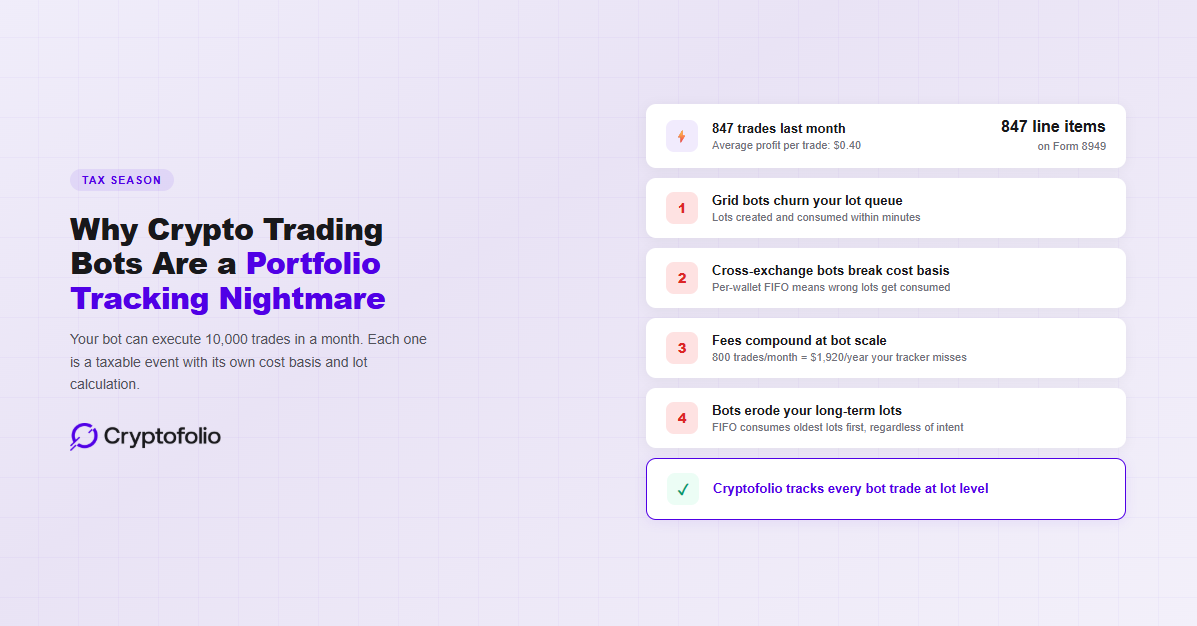
Your trading bot executed 847 trades last month. You know this because your exchange dashboard told you. What you probably do not know is the tax liability those 847 trades created.
Every single trade a bot executes is a taxable event. It does not matter that a bot placed them. It does not matter that 600 of them were tiny grid trades that each made $0.40. It does not matter that you were asleep when they happened. Each one is a disposal of one asset and an acquisition of another, and each one requires a cost basis calculation, a lot selection, and a gain or loss determination.
Manual traders might execute 50 trades in a year. A grid bot on a single pair can do that in a day. The tax logic is the same. The volume is not.
Every Bot Trade Is a Taxable Event
The IRS treats cryptocurrency as property. When you sell, trade, or exchange one crypto asset for another, you have a taxable event. This applies regardless of whether you clicked the button or a bot did. There is no exemption for automated trading, algorithmic strategies, AI-driven execution, or high-frequency bots. The decision-making logic behind the trade is irrelevant.
Every bot trade is a taxable disposal regardless of execution method. Whether your bot uses a simple grid algorithm, a DCA schedule, or an AI model analyzing market sentiment, the tax treatment is identical: each execution is a disposal that requires cost basis, lot selection, and gain or loss reporting. Automated strategies receive no special exemption under current IRS rules.
A grid bot that places buy and sell orders at every $50 price increment on an ETH/USDT pair might execute 30 trades in a single day. Over a month, that is 900 transactions. Over a year, 10,800. Each one needs to be reported on Form 8949 with the correct date, proceeds, cost basis, and gain or loss.
A DCA bot that buys $100 of BTC every day creates 365 separate tax lots per year. When you eventually sell, the lot that gets consumed depends on your accounting method and which wallet the sale happens from. If you are using FIFO, the oldest lot goes first. If you have been running the bot for two years, that is 730 lots in the queue for a single asset on a single exchange. (For more on lot selection methods, see our FIFO vs. LIFO guide.)
An arbitrage bot that buys on one exchange and sells on another within seconds creates a buy on Exchange A and a sell on Exchange B. Under the IRS per-wallet requirement (Rev. Proc. 2024-28), those are two separate lot queues. The buy creates a lot on Exchange A. The sell consumes a lot on Exchange B. If you have been running the arb bot for months, Exchange B's lot queue may contain lots from manual buys you did six months ago, not the lot the arb bot just created on Exchange A. The cost basis on the consumed lot could be completely different from what the bot paid moments earlier.
The Grid Bot Problem
Grid bots are the most popular automated strategy in crypto. They place a grid of buy and sell orders across a price range and profit from volatility by buying low and selling high within the grid. Simple in concept. A tracking disaster in practice.
Consider a grid bot running on ETH/USDT with a range of $2,500 to $3,500 and 20 grid levels. The bot places buy orders at $2,500, $2,550, $2,600, and so on, with corresponding sell orders $50 higher. Every time ETH drops to a grid level, the bot buys. Every time it rises to the next level, the bot sells.
In a volatile market, the same grid levels can be triggered multiple times per day. Each buy creates a new tax lot. Each sell consumes a lot from the queue. If the bot buys at $2,600, sells at $2,650, then the price drops and it buys at $2,600 again, that is three separate taxable events with three separate cost basis calculations.
Over a month of moderate volatility, a 20-level grid bot can easily generate 500 to 1,000 trades. The individual profit on each trade might be $0.30 to $2.00. But every single one is a line item on Form 8949. The IRS does not have a de minimis threshold for reporting. A $0.30 gain is reported the same way as a $30,000 gain.
The tracking challenge is not just volume. It is that grid bots create a rapidly churning lot queue. Lots are created and consumed within hours or minutes. The cost basis on each consumed lot depends on what was already in the queue, which depends on every prior bot trade plus any manual trades you made on the same exchange. If your tracker cannot process this volume at lot-level granularity, the cost basis and gain calculations will be wrong.
Cross-Exchange Bots Break Cost Basis
The tracking problem gets significantly worse when bots operate across multiple exchanges.
An arbitrage bot spots a price difference between Binance and Kraken. It buys 1 ETH on Binance at $2,995 and sells 1 ETH on Kraken at $3,005. The profit is $10 minus fees.
The buy on Binance creates a new lot in your Binance lot queue. The sell on Kraken does not consume that lot. Under the per-wallet tracking requirement, Kraken has its own lot queue. The sell on Kraken consumes whatever lot is first in Kraken's FIFO queue, which might be ETH you bought on Kraken three months ago at $2,200.
This is not an error. It is how per-wallet FIFO actually works. But it means the tax outcome of the arb trade is completely different from the economic outcome, and no amount of bot configuration can change that. Only accurate lot-level tracking across both exchanges can produce the correct numbers. (For more on how cross-wallet transfers affect cost basis, see our transfer guide.)
Fees Compound at Bot Scale
Manual traders might pay gas or exchange fees on 50 trades per year. A bot trader pays fees on thousands. The cumulative impact is significant and frequently invisible.
A grid bot executing 800 trades per month on Binance with a maker fee of 0.1% and an average trade size of $200 pays $0.20 per trade. Over a month, that is $160 in fees. Over a year, $1,920. These fees should adjust the cost basis on purchases (increasing it) and reduce proceeds on sales. If your tracker ignores fees, your reported gains are overstated by nearly $2,000.
On-chain bots pay gas fees on every transaction. A bot executing 50 swaps per day on Uniswap at an average gas cost of $3 spends $150 per day, $4,500 per month, and $54,750 per year on gas alone. Each gas fee is a separate taxable disposal of ETH through the FIFO lot queue. That is 18,250 additional taxable events per year from gas alone, on top of the trades themselves. (For more on how gas fees affect cost basis, see our cost basis guide.)
If your tracking tool does not capture fees at this volume, it is missing tens of thousands of dollars in costs and taxable events.
Short-Term vs. Long-Term Gets Complicated
Bot trades are almost always short-term. A grid bot that buys and sells within the same day generates short-term capital gains taxed at your ordinary income rate, which for most active traders is significantly higher than the 15% long-term rate.
But here is where it gets complicated. If you also hold long-term positions on the same exchange, the bot's sell orders might consume your long-term lots first under FIFO. You intended for the bot to trade its own lots, but FIFO does not care about intent. It consumes the oldest lot, which might be the ETH you bought 18 months ago for long-term holding.
When a bot runs on the same exchange where you hold long-term positions, FIFO will consume your oldest lots first, including long-term holdings you never intended to sell. Your bot is eroding your long-term lot inventory without you realizing it. The gain on the consumed lot may qualify as long-term, but the lot is gone permanently. Future sales of what you thought were long-term holdings will draw from the newer, short-term lots the bot created.
The result: your long-term lot gets consumed by a bot trade. The gain is actually long-term because the lot was acquired 18 months ago, but you lose that lot from your queue permanently. When you eventually want to sell your long-term holdings intentionally, the remaining lots may all be newer ones the bot created recently. Those are short-term lots. The sale you planned as a long-term capital gain at 15% becomes a short-term gain taxed at your ordinary income rate.
The only way to prevent this is to run bot trades on a separate exchange account from your long-term holdings, or to use Specific Identification to designate which lots the bot trades consume. Both require lot-level visibility that most trackers cannot provide.
What Your Tracker Needs to Handle Bot Trading
Most portfolio trackers and tax tools are designed for manual trading volumes. They work fine for 100 transactions per year. They start breaking at 1,000. By 10,000, the problems are structural.
Here is what a tracker needs to handle bot trading correctly:
Lot-level processing at scale. Every bot trade creates or consumes a lot. The tracker needs to maintain a per-wallet FIFO queue that processes thousands of entries without errors or approximations. If the system aggregates trades or averages cost basis to handle volume, the individual lot calculations are wrong.
Fee capture on every trade. Exchange fees and gas fees need to be captured and applied to cost basis on every single trade, not estimated or ignored. At bot scale, the cumulative fee impact runs into thousands of dollars per year.
Per-wallet lot isolation. If you run bots across multiple exchanges, each exchange's lot queue must be independent. A sell on Kraken cannot consume a lot from Binance. The tracker must enforce this separation natively. (For the full explanation of per-wallet requirements, see our FIFO vs. LIFO guide.)
Historical import from account creation. If the tracker starts from the connection date, every lot created before that date has unknown cost basis. For a bot that has been running for months before you connected the tracker, hundreds or thousands of lots are missing. The entire lot queue is wrong from the start. (For more on why starting from connection date breaks cost basis, see our P&L tracker guide.)
Processing speed that matches trading speed. If your bot executes 50 trades per day and your tracker takes 10 seconds to process each one, the tracker is always behind. Real-time or near-real-time processing is not optional for bot traders.
How Cryptofolio Handles Bot Volume
Cryptofolio processes every transaction at lot level regardless of volume. A grid bot generating 1,000 trades per month is processed with the same lot-level granularity as a manual trader placing 10 trades per year. Each trade creates or consumes a lot, adjusts for fees, and updates the per-wallet FIFO queue.
Historical import from account creation means every lot the bot created before you connected is included in the queue. Your cost basis calculations are accurate from the first bot trade, not from the day you decided to start tracking.
Exchange fees are captured and applied to cost basis on every trade automatically. Gas fees on on-chain bot transactions are tracked as separate taxable events through the native token's lot queue. None of these are estimated or ignored.
Per-wallet lot isolation is enforced natively. If you run bots on Binance and also hold long-term positions on Kraken, the two lot queues are completely independent. A bot sell on Binance consumes a Binance lot. A sell on Kraken consumes a Kraken lot. There is no cross-contamination.
Your bot trades in seconds. Your tracker should keep up.
Cryptofolio processes every bot trade at lot level with accurate cost basis, fee tracking, and per-wallet lot isolation. No aggregation. No approximation.
The Bottom Line
Trading bots amplify every tracking problem that exists for manual traders. The same issues with cost basis, lot selection, fee tracking, and per-wallet isolation apply, but at 10x to 100x the volume.
A bot that executes 10,000 trades per year creates 10,000 taxable events, each requiring accurate cost basis, correct lot selection, and proper fee adjustment. If your tracker cannot handle that volume at lot-level precision, the numbers it produces are not approximations. They are wrong.
The convenience of automated trading comes with an automated tracking requirement. If your bot runs 24/7, your tracker needs to keep up.
(For more on how different tracking tools handle volume and accuracy, see our tool comparison guide. For a broader look at why P&L calculations break, see our P&L tracker guide.)
Disclaimer: This article is for informational purposes only and does not constitute legal, tax, financial, or investment advice. Cryptocurrency tax rules are complex, depend on your specific situation, and are subject to frequent regulatory changes. While we strive to keep our content accurate and up to date, information in this article may become outdated as policies evolve. Consult a qualified professional for advice on your individual circumstances.