How Much Did You Really Make in Crypto?
Your portfolio app shows your balance. It doesn't show what you paid, what you lost, or what you actually made. Here's why the number on your screen is wrong and what it takes to calculate the real one.
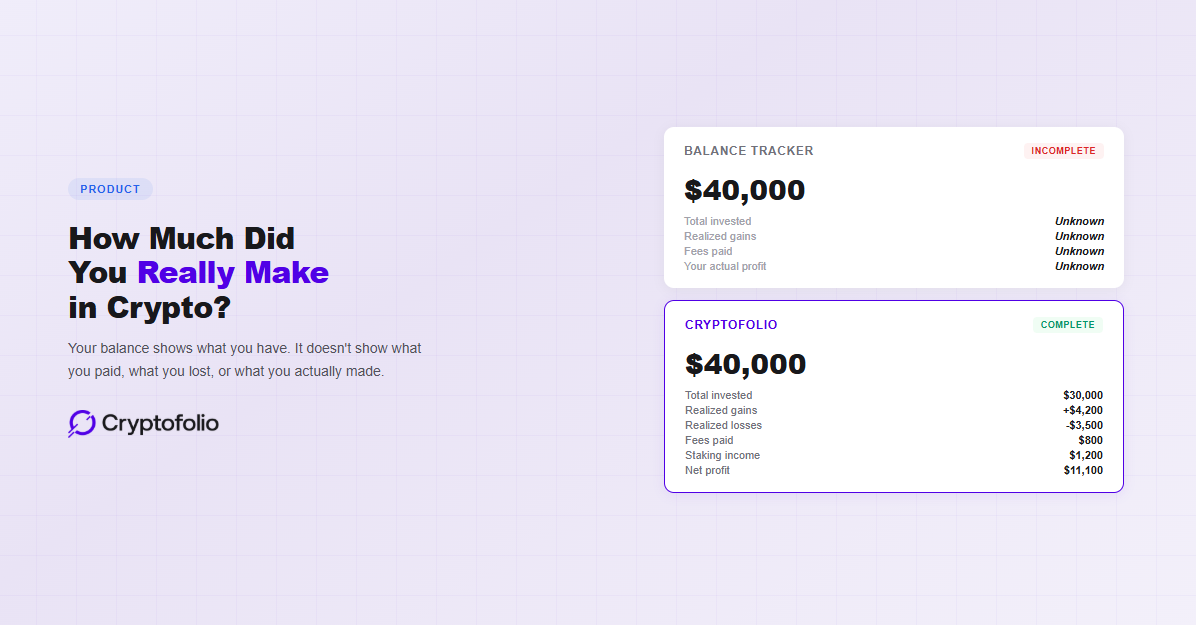
Open your portfolio app right now. Look at the number at the top of the screen. That number is your balance. It tells you what your crypto is worth at this moment. It does not tell you what you made.
Your profit is a different number. It requires knowing what you paid for every asset, when you paid it, what fees you spent along the way, what you've already sold and at what price, and what income you've received from staking or airdrops. Most portfolio apps don't track any of this. They show your balance and let you assume the rest.
The difference between those two numbers can be thousands of dollars. Sometimes tens of thousands. And most people have never calculated the real one.
Why Your Balance Is Not Your Profit
Your portfolio balance is simple. It's the total market value of everything you currently hold. If you have 2 ETH and ETH is $3,000, your balance is $6,000. Every portfolio app gets this right because it only requires one input: the current price.
Your profit requires a second input: what you paid. And not just a single purchase price. If you bought ETH five times over two years at five different prices, your profit depends on the weighted average of those purchases, adjusted for any ETH you've sold, transferred, staked, swapped, or spent on gas fees along the way.
Consider a straightforward example. You buy 1 ETH at $2,000. The price goes to $3,000. Your balance is $3,000 and your profit is $1,000. Simple enough.
Now add one complication. You bought 0.5 ETH at $1,500 and 0.5 ETH at $2,500. Your total cost is $2,000. ETH goes to $3,000. Your balance is still $3,000 and your profit is still $1,000. But your tracker doesn't know that unless it recorded both purchases.
Now add a transfer. You moved 0.3 ETH from Coinbase to MetaMask. Your Coinbase balance dropped, your MetaMask balance appeared, and most trackers treat the incoming MetaMask ETH as if it has no history. If you later sell from MetaMask, the tracker doesn't know what you paid for it, so it can't calculate your gain.
This is how the number starts drifting. Every transfer, every swap, every DeFi interaction is a point where cost basis can break, and once it breaks, the profit number is wrong from that point forward. Liquidity pool positions are a particularly common blind spot — the underlying asset composition shifts automatically as trades flow through the pool, and most trackers collapse the entire position into a single dollar value. For a full breakdown of what trackers get wrong about LP positions, see our liquidity pool tracking guide.
The Five Reasons Your Number Is Wrong
There are five specific ways that portfolio apps miscalculate your profit. Each one is common, and most portfolios have at least two or three happening simultaneously.
Tracking started when you connected. Most trackers begin recording your portfolio from the day you connect your wallet or exchange. Everything before that date has no purchase history. The tracker assigns today's price as the cost basis for assets you bought months or years ago. If you bought ETH at $800 and connected your tracker when ETH was at $2,500, the tracker thinks you paid $2,500. Your real gain is $2,200 per ETH. The tracker shows $500. For a full breakdown of why this matters, see our guide on what your portfolio app isn't telling you.
Transfers reset your cost basis. When you move crypto between wallets, the sending side shows a withdrawal and the receiving side shows a deposit. If the tracker doesn't connect those two events, the receiving wallet has no idea what you originally paid. The original cost basis is lost, and the tracker substitutes the market price at the time of transfer. This happens on every cross-platform move, and for DeFi users who transfer between wallets frequently, the cumulative error is significant. We covered this in detail in our guide to how crypto transfers break your cost basis.
Fees are missing from your P&L. Exchange fees, gas fees, bridge fees, protocol fees. Every fee you've paid either increases your cost basis on purchases or reduces your proceeds on sales. Gas fees paid in ETH are taxable disposals that run through your FIFO lot queue. Over the course of a year, an active DeFi user accumulates hundreds of fee transactions. If your tracker doesn't account for fees, your profit is overstated by the total amount you've spent on them. We wrote a full breakdown of how gas fees silently eat your crypto profits.
Staking income is miscounted. Staking rewards are ordinary income at the fair market value when you receive them. Each reward creates a new tax lot with its own cost basis. A single ETH staker across two wallets generates hundreds of tax lots per year. Most trackers either ignore staking income entirely or count it as part of your balance without recording the individual lots. Either way, the cost basis on those rewards is missing, which means the gain or loss when you eventually sell is wrong. For a detailed look at how staking lots are tracked across wallets, see our guide on tracking crypto staking rewards across wallets.
Your lot queue is broken. FIFO (First In, First Out) determines which lot gets sold first. If your tracker missed a gas fee, a staking reward, or a transfer, the lot queue is out of order. Every sale after that pulls from the wrong lot, which means the wrong cost basis, the wrong holding period (short-term vs. long-term), and the wrong gain or loss. One missing transaction early in the queue cascades through every subsequent sale. For a complete breakdown of how each of these gaps compounds inside your P&L number, see our crypto P&L tracker guide.
The DCA Problem
Dollar-cost averaging is one of the most popular crypto strategies. Buy a fixed amount every week or month regardless of price. It's simple, disciplined, and widely recommended.
It also makes your profit calculation harder than most people realize.
Say you invest $500 per month in ETH for 12 months. ETH starts at $2,000 and ends at $3,000, a 50% price increase. Your portfolio balance at the end is about $7,325.
You invested $6,000. So your profit is $1,325. That's a 22% return on your money.
The asset went up 50%. You made 22%. That's not a mistake. It's just how DCA math works. Your earlier purchases had more time to appreciate. Your later purchases were made at higher prices with less upside. The blended return is always lower than the headline price change.
Most portfolio apps show you the asset's performance (50% up) next to your balance and let you think that's your return. It isn't. Your return depends on when each purchase was made and at what price. Without per-lot tracking, the app literally cannot calculate your actual return.
What “Knowing Your Number” Actually Requires
Calculating your real crypto profit requires four things working together.
Complete transaction history. Not from the day you connected. From the first transaction in every wallet and exchange you've ever used. Every buy, sell, swap, transfer, staking reward, airdrop, and gas fee. If any transaction is missing, the cost basis chain is broken.
Per-lot cost basis. Every acquisition creates a tax lot with a specific date, price, and quantity. These lots live in a queue (FIFO by default) within each wallet. When you sell, the lot at the front of the queue determines your gain or loss. Aggregating across wallets or using average cost hides the real numbers. For a full explanation of how lot ordering works, see our FIFO vs. LIFO guide.
Cross-platform continuity. When you transfer ETH from Coinbase to MetaMask, the cost basis has to follow. When you bridge from Ethereum to Avalanche, the cost basis has to follow. When you wrap ETH to WETH, the cost basis has to follow. Every time your asset moves, the tracker needs to maintain the connection between where it came from and what you paid for it.
Fee accounting. Every fee either adjusts your cost basis or reduces your proceeds. Exchange trading fees, gas fees, bridge fees, protocol fees. If fees are treated as invisible costs that disappear from your records, your profit is overstated by exactly the amount you spent on them. For a breakdown of what a full-featured portfolio tracker captures vs. what balance trackers miss, see our balance tracker vs. portfolio tracker guide.
How Cryptofolio Answers the Question
Cryptofolio is built to answer one question: how much did you actually make?
When you connect a wallet, Cryptofolio imports your entire transaction history from the wallet's creation date. Not from the day you connected. From the first transaction. This means every purchase has its original cost basis, every transfer is linked between source and destination, and the lot queue reflects reality from day one.
Cost basis is tracked per lot, per wallet. When you sell, the gain or loss is calculated against the specific lot that FIFO selects from that wallet's queue. Staking rewards create individual lots at the FMV when received. Gas fees run through the lot queue as disposals. Nothing is averaged, aggregated, or estimated. For a full overview of how Cryptofolio works and what it tracks, see our guide on what Cryptofolio is and how it works. For a breakdown of what any tracker should need from you versus what it should never ask for, see our guide on tracker security.
The result is a profit number you can trust. Not a balance. Not an estimate. The actual difference between what you put in and what you got out, accounting for every transaction, every fee, and every movement across your entire portfolio. For a step-by-step guide on tracking your portfolio correctly, including what to connect and how to verify your cost basis is accurate, see our tracking guide.
Most portfolio apps show your balance. Cryptofolio shows your profit.
Cryptofolio tracks cost basis per lot, per wallet, from the first transaction in every connected account. The profit number on your screen is always the real one.
The Bottom Line
Your balance tells you what your crypto is worth right now. Your profit tells you what you actually made. They are different numbers, and the second one is much harder to calculate.
Most portfolio apps only give you the first one. They show your holdings at current prices and call it tracking. The moment you've transferred crypto between platforms, used DeFi, earned staking rewards, or even just paid gas fees, the profit calculation requires infrastructure those apps don't have.
If you don't know what you paid for every asset in every wallet, you don't know your number. You're looking at a balance and guessing.
Disclaimer: This article is for informational purposes only and does not constitute legal, tax, financial, or investment advice. Cryptocurrency tax rules are complex, depend on your specific situation, and are subject to frequent regulatory changes. While we strive to keep our content accurate and up to date, information in this article may become outdated as policies evolve. Consult a qualified professional for advice on your individual circumstances.