What Your Portfolio App Isn't Telling You
Your portfolio app shows what your crypto is worth. It doesn't show what you actually made. Here's why the number on your screen is misleading and what's missing.
Open your portfolio app. Look at the number at the top of the screen. That is what your crypto is worth right now. It is not what you made.
Most people treat that number as their profit. It is not. It is your balance. Your profit is a completely different number, and your app probably does not show it.
The difference between the two is the most important gap in crypto portfolio tracking, and almost nobody talks about it.
Balance Is Not Profit
Your balance is simple. Take every token you hold, multiply by the current price, add them up. That is your portfolio value. Every app does this. CoinStats, DeBank, Zerion, the Coinbase dashboard. They all show you the same number.
Your profit is harder. It requires knowing what you paid for each token, when you bought it, what fees you paid, what income you earned along the way, and what the tax implications are when you sell. Your app needs to subtract what you put in from what you have now, accounting for every transaction in between.
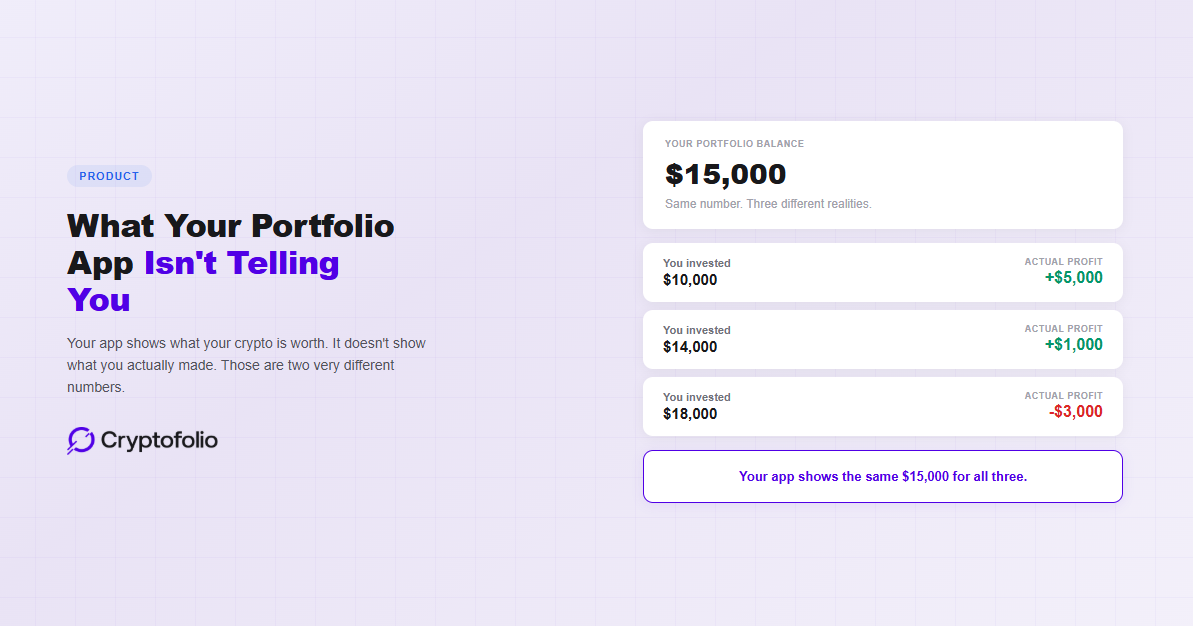
Here is a simple example. You have $15,000 worth of crypto in your portfolio. Your app shows $15,000. Looks good.
But what did you put in? The same $15,000 balance represents three completely different financial outcomes depending on your investment:
Same $15,000 balance. Three completely different outcomes.
Your app shows the same number for all three. That is the gap between balance and profit.
Why Your App Does Not Show the Real Number
Calculating real profit requires something most apps do not have: your complete transaction history with accurate cost basis on every asset.
Cost basis is what you originally paid for a token, including fees. It sounds simple, but it breaks in predictable ways.
You bought at different times. If you bought 1 ETH at $1,500 in January and another 1 ETH at $3,000 in June, your average cost basis is $2,250. But the IRS does not use averages for crypto. Each purchase is a separate lot with its own cost basis and holding period. When you sell 1 ETH, which one did you sell? The $1,500 one or the $3,000 one? The answer changes your profit by $1,500. For more on how lot selection works, see our FIFO vs. LIFO guide.
You transferred between wallets. When you move ETH from Coinbase to MetaMask, the cost basis should follow. Most apps do not link the send and receive transactions, so the receiving wallet has no idea what you originally paid. Your cost basis either resets to the current price or disappears entirely. For the full breakdown, see our transfer guide.
You interacted with DeFi. Depositing into Aave, providing liquidity on Uniswap, staking on Lido. Each of these changes the form of your assets while the underlying value and cost basis need to follow through every step. Most apps treat DeFi positions as separate from your portfolio rather than tracking the full lifecycle. See our DeFi tracking guide.
You earned income. Staking rewards, lending interest, airdrops. Each of these is taxable income at the fair market value when received, and each one creates a new tax lot with its own cost basis. If your app does not classify income events and create lots, your profit number is wrong in two ways: the income is not counted, and the cost basis on those tokens is missing. For more on how airdrops create hidden tax events, see our airdrop tax guide.
You paid gas fees. Every on-chain transaction costs gas. Every gas fee is a taxable disposal of the native token that runs through your lot queue. If your app ignores fees, it is overstating your profit by the total amount of gas you have ever paid. For active DeFi users, that can be thousands of dollars per year. See our cost basis guide.
Each of these gaps makes the profit number less accurate. Combined, they can produce a number that is thousands of dollars off from reality.
The DCA Illusion
Dollar-cost averaging is one of the most popular strategies in crypto. Buy a fixed amount every week or every month, regardless of price. The strategy is sound. The way most people measure its performance is not.
Here is a real scenario. You buy $500 of ETH every month for 12 months. Your total investment is $6,000. ETH started at $2,000 and ended at $3,000, a 50% price increase. Your portfolio is not up 50%.
Your app shows the asset is up 50%. Your personal return is less than half that.
Because you bought at different prices throughout the year, your actual return depends on the weighted average of all your purchase prices. The first $500 bought at $2,000 has gained more than the last $500 bought near $3,000. Your actual return on invested capital is roughly 22%, less than half the headline price change.
Most portfolio apps show you the current price change of the asset. They do not show you the return on your actual invested dollars. If you are DCA-ing into an asset, the number on your screen overstates your return by a significant margin. The more consistent your DCA schedule, the bigger the gap between the asset's price change and your personal return.
This is not a flaw in DCA as a strategy. It is a flaw in how the result is presented. Your app is showing you how the asset performed. It is not showing you how you performed.
What “How Much Did I Make” Actually Requires
To answer the question of how much you actually made in crypto, you need more than a balance. You need a complete accounting of every dollar that went in and every dollar that came out or is still inside.
That means tracking your total invested capital across every purchase on every platform. It means carrying cost basis through every transfer, swap, bridge, and DeFi interaction. It means recognizing income from staking, lending, and airdrops at the fair market value when received. It means tracking every gas fee and exchange fee as a real cost. It means maintaining separate lot queues per wallet to comply with IRS requirements under Revenue Procedure 2024-28.
The final number is not your balance. It is your net profit after all costs, all income, all fees, and all tax lots are accounted for. That number might be higher than what your app shows (if you earned income your app does not track). It might be lower (if your app ignores fees you paid). Either way, it is the real number.
For a deeper look at why the balance and profit numbers diverge and what it takes to calculate your actual return, see our guide on how much you really made in crypto.
The Numbers Your App Should Show You
A portfolio app that answers “how much did I make” needs to show more than one number. Here is what a real performance view looks like.
Net worth. What your crypto is worth right now. Every app shows this.
Cost basis. What you paid for everything you currently hold, including fees. This is the number most apps do not show.
Net profit. Net worth minus cost basis. This is your actual unrealized gain or loss on your current holdings.
Realized gains. Profit or loss from assets you have already sold. Your app needs to remember what you sold, what you paid for it, and what you received.
Income earned. Staking rewards, lending interest, airdrops, and any other tokens received as income. Each recognized at fair market value when received.
Fees paid. Gas fees plus exchange fees. Real costs that reduce your profit.
If your app only shows the first number, it is showing you 16% of the picture. The other five are where the actual financial story lives. For more on why P&L calculations go wrong without these numbers, see our P&L tracker guide.
What Happens When You Only See Balance
When balance is the only number you see, you make decisions based on incomplete information.
You think you are up when you are actually down. You invested $14,000, your portfolio shows $15,000, and you feel good. But you paid $800 in gas fees and $200 in exchange fees that your app never tracked. Your actual profit is $0. You are exactly where you started.
You sell at what you think is a gain and discover at tax time that the cost basis was different from what you assumed. The tax bill is higher or lower than expected because the profit your app showed you was not the profit the IRS calculates.
You compare your performance to the market and think you are keeping up, but your personal return is lower than the asset's price change because of DCA timing, fees, and income events your app did not track.
You have no idea whether your DeFi positions are actually profitable after gas fees, impermanent loss, and income tax on rewards are factored in.
Each of these is a real consequence of tracking balance instead of profit. And each one is avoidable with the right data.
How Cryptofolio Shows What You Actually Made
Cryptofolio is built around answering one question: how much did you actually make?
The home screen shows net worth and cost basis side by side. The performance section breaks down net income, realized gains, and unrealized gains for any time period. You can see exactly what you put in, what you took out, and what you made or lost.
Every transaction is imported back to when each wallet was created, not from when you signed up. That is what makes the cost basis accurate from day one. Transfers between your own wallets are linked automatically so cost basis follows your crypto wherever it goes. Gas fees and exchange fees are tracked as first-class costs. Staking rewards, lending interest, and airdrops are classified as income at fair market value when received.
The result is that the number on the screen is your actual profit, not your balance. When you open Cryptofolio, you see how much you really made. Not an approximation. Not a balance that looks like profit. The real number.
Your balance tells you what you have. Your cost basis tells you what you made.
Cryptofolio shows both. Net worth, cost basis, realized gains, unrealized gains, income, and fees. All tracked from your first transaction.
The Bottom Line
The number at the top of your portfolio app is not your profit. It is your balance. The two can be thousands of dollars apart, and most apps do not show you the difference.
Your real profit depends on what you paid for every token, what fees you paid along the way, what income you earned from staking and airdrops, and which lots are consumed when you sell. Without that data, the number on your screen is just a snapshot of current value, not a measure of actual performance.
If you have ever looked at your portfolio and wondered whether you actually made money or just feel like you did, that is the gap between balance and profit. Closing it requires tracking everything from the start.
For a broader look at how P&L calculations break, see our P&L tracker guide. For the difference between balance trackers and portfolio trackers, see our comparison guide.
Disclaimer: This article is for informational purposes only and does not constitute legal, tax, financial, or investment advice. Cryptocurrency tax rules are complex, depend on your specific situation, and are subject to frequent regulatory changes. While we strive to keep our content accurate and up to date, information in this article may become outdated as policies evolve. Consult a qualified professional for advice on your individual circumstances.