How Gas Fees Silently Eat Your Crypto Profits
Every gas fee you pay in ETH is a taxable disposal that consumes a lot from your FIFO queue. Most trackers ignore this entirely. Here's how gas fees actually affect your cost basis, your P&L, and your tax bill.
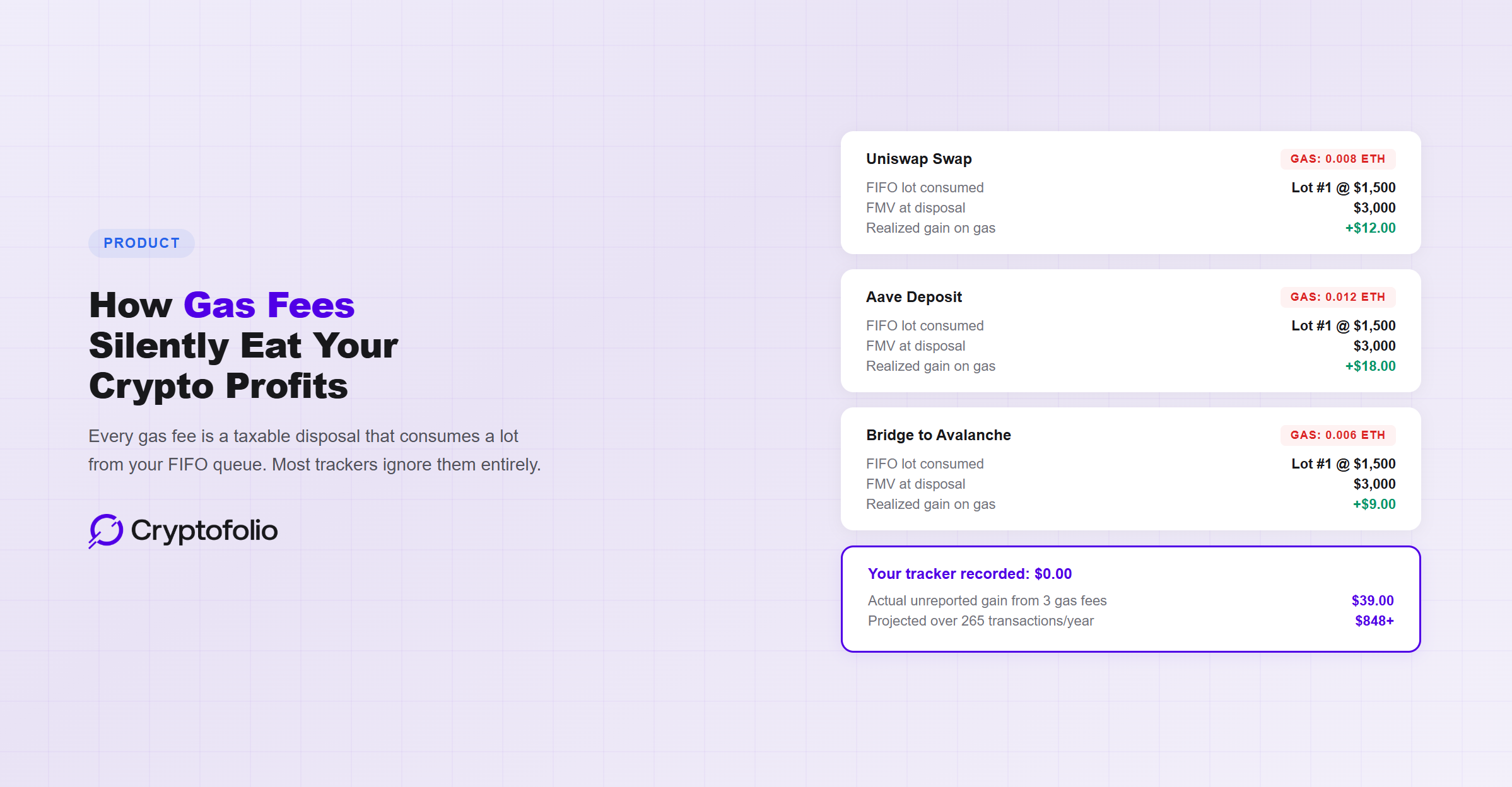
Every time you interact with a blockchain, you pay a gas fee. Swap on Uniswap, deposit into Aave, bridge to Avalanche, transfer ETH to another wallet. Each one costs gas. Most people treat gas fees the way they treat ATM fees: an annoying cost that disappears from their mind the moment the transaction goes through.
The IRS treats them differently. A gas fee paid in ETH is a disposal of ETH. That disposal runs through your FIFO lot queue. It has its own cost basis, its own gain or loss calculation, and its own impact on your portfolio's P&L. Every gas fee you've ever paid in crypto is a taxable event that most portfolio trackers never recorded.
For casual holders who make a few transactions per year, the impact is small. For active DeFi users with hundreds of on-chain interactions, untracked gas fees can represent thousands of dollars in unreported gains or losses and a P&L that's wrong by a meaningful amount.
Why Gas Fees Are Taxable Events
The IRS classifies gas fees as "digital asset transaction costs" (IRS FAQ A53). The definition is broad: any amount paid in cash or property, including digital assets, for services to effect a purchase, sale, or disposition.
When you pay gas in ETH, you are disposing of ETH. You are exchanging a portion of your ETH holdings for a service (network validation). That exchange is a taxable event. The ETH consumed by the gas fee has a cost basis (whatever you paid for it under FIFO), and the disposal creates a capital gain or loss based on the difference between that basis and the fair market value at the time you paid the fee.
This is true regardless of what the gas fee was paying for. Whether you paid gas to execute a swap, a transfer, a deposit, or a failed transaction, the disposal of the gas token itself is a separate taxable event. For a broader look at how the IRS treats DeFi activity including gas, see our complete DeFi tax guide.
How Gas Fees Hit Your FIFO Queue
When you pay 0.005 ETH in gas to execute a Uniswap swap, that 0.005 ETH comes from your FIFO lot queue. The oldest lot in the wallet where you paid the fee gets partially consumed.
If you bought ETH at $1,500 two years ago and ETH is now $3,000, that 0.005 ETH gas fee generates a capital gain of $7.50. Small on its own. But 200 DeFi transactions over a year at similar gas costs means 200 separate FIFO disposals that most trackers never record.
The cumulative effect goes beyond the gains and losses on the gas itself. Every gas disposal shifts your FIFO queue. The oldest lot gets consumed slightly faster than your tracker thinks. When you eventually sell a larger amount, the lot that FIFO pulls from may be different than what your tracker expected because the queue has been gradually depleted by gas fees it never tracked.
This is how untracked gas fees create cascading errors in your P&L. It's not just the gas cost that's missing. It's the downstream effect on every subsequent sale. For a detailed explanation of how cost basis errors compound through your portfolio, see our cost basis guide.
Different Transactions, Different Treatment
The IRS treats gas fees differently depending on what transaction the gas was paying for. The 2024 Final Regulations and updated IRS FAQs established clear rules for each scenario.
Gas on purchases. The gas fee is added to your cost basis for the asset you're buying (IRS FAQ A56). If you buy 1 ETH for $2,000 and pay $50 in gas, your cost basis is $2,050. This reduces your taxable gain when you eventually sell. Most trackers handle this correctly because exchanges typically include fees in the purchase price.
Gas on sales. The gas fee reduces your amount realized (IRS FAQ A52). If you sell ETH for $3,000 and pay $80 in gas, your amount realized is $2,920. This also reduces your taxable gain. Again, exchanges usually handle this automatically.
Gas on swaps. This is where most trackers get it wrong. Under IRS FAQ A72 (from the 2024 Final Regulations), gas on a swap reduces the proceeds on the asset you're disposing of. It does not get added to the cost basis of the asset you're receiving. Before FAQ A72, many tax tools split gas between both sides or added it to the acquired asset's basis. Both approaches are now incorrect for tax year 2025 onward.
Gas on transfers between your own wallets. The transfer itself is not a taxable event. But the gas you pay to execute it is a disposal of the gas token. You recognize a gain or loss on the ETH consumed based on your FIFO lot queue. The gas cost on a transfer is not deductible for individual investors. Miscellaneous investment expense deductions under IRC Section 212 were suspended by the TCJA in 2018 and permanently eliminated by the OBBBA in 2025. For more on how transfer costs and cost basis interact, see our crypto transfer cost basis guide.
Gas on failed transactions. You still paid the gas even though the transaction failed. The IRS has not issued specific guidance on failed transactions, but the conservative position treats the gas disposal the same way as any other: the ETH is gone, the FIFO lot is consumed, and you recognize a short-term capital loss equal to the difference between your basis and the FMV at the time of the failed transaction.
The Numbers Most People Ignore
Consider a moderately active DeFi user over the course of a year. They execute 150 swaps, 30 liquidity pool interactions, 20 staking deposits and withdrawals, 15 bridge transactions, and 50 wallet transfers. That's 265 on-chain transactions. Each one paid gas.
At an average gas cost of $8 per transaction (a reasonable estimate for Ethereum during moderate congestion), that's $2,120 in gas fees over the year. All paid in ETH. All consuming lots from the FIFO queue. All generating their own gains or losses.
If the user's average ETH cost basis is $1,800 and the average price at the time of paying gas was $3,000, each gas disposal generates a capital gain. On $2,120 in gas, the gain would be roughly $848. At a 30% combined tax rate, that's $254 in taxes on gas disposals alone that most trackers would never surface.
The flip side is equally important. If the user's cost basis is higher than the current price (they bought ETH at $3,500 and are paying gas when ETH is at $2,500), those gas disposals generate capital losses. Losses that could offset other gains but go unclaimed because nobody tracked them.
Either way, the numbers are wrong. You're either underreporting gains or missing losses. Both create problems. For a full picture of how missing fee data corrupts your P&L, see our guide on why your crypto P&L is wrong.
Why Most Trackers Miss This
Portfolio trackers miss gas fees for a structural reason: they track balances, not lots.
When a balance tracker sees your ETH balance drop by 0.005, it records the change. But it doesn't know which lot that 0.005 came from, what the cost basis was, or what gain or loss resulted from the disposal. It just sees a smaller number.
Tax tools handle gas slightly better on buy and sell transactions because exchanges typically report fees as part of the trade. But for on-chain transactions (swaps on DEXs, DeFi interactions, bridges, transfers), the gas fee data comes from the blockchain itself. Parsing that data, identifying the gas payment, matching it to the correct wallet's FIFO queue, and calculating the gain or loss requires infrastructure that most trackers haven't built.
The result is a portfolio that looks right at the balance level but is wrong at the P&L level. Your ETH balance accurately reflects what you hold. Your cost basis, your realized gains, and your FIFO queue state do not. For a detailed walkthrough of how gas fees and other missing data affect DeFi cost basis specifically, see our DeFi cost basis guide.
What Correct Gas Fee Tracking Looks Like
A tracker that handles gas fees correctly does four things.
It records every gas payment as a separate line item in your transaction history. The gas fee is not bundled with the primary transaction. It exists as its own event with its own timestamp, amount, and wallet source.
It runs the gas disposal through the FIFO lot queue of the wallet where the gas was paid. The oldest lot in that wallet is partially consumed. The gain or loss is calculated against the cost basis of that specific lot and the FMV at the time of the gas payment.
It applies the correct treatment based on the transaction type. Gas on a purchase adds to cost basis. Gas on a sale reduces amount realized. Gas on a swap reduces proceeds on the disposed asset only. Gas on a transfer is a standalone disposal with no deduction.
It updates the FIFO queue state so that all subsequent disposals from that wallet use the correct lot ordering. Without this step, every sale after an untracked gas disposal pulls from the wrong lot.
Bridge Gas Fees: A Specific Case
Bridge transactions illustrate why gas fee tracking matters beyond the fee itself. When you bridge ETH from Ethereum to Avalanche, you pay a gas fee on the source chain to initiate the bridge. That gas fee is a disposal of ETH running through your Ethereum wallet's FIFO queue, completely independent of the bridge transfer itself.
Most trackers that handle the bridge transfer correctly (carrying cost basis across chains) still miss the gas fee disposal. So your bridged asset arrives on the destination chain with the right cost basis, but the source chain's lot queue is slightly wrong because the gas disposal was never recorded. For the full picture of how bridge transactions affect your cost basis including fee treatment, see our guide on what happens to your cost basis when you bridge crypto.
How Cryptofolio Handles Gas Fees
Cryptofolio treats gas fees as first-class ledger data. Every gas payment is tracked as a separate disposal running through the wallet's FIFO queue. The gain or loss on each gas fee is calculated automatically based on the lot consumed and the market price at the time of payment.
This means your P&L reflects the true cost of every on-chain interaction. The hundreds of small disposals that other trackers ignore are accounted for in your realized gains, your FIFO queue state, and your tax-ready export.
For DeFi users, this is the difference between a P&L that's approximately right and one that's actually right. Gas fees are not a rounding error for active portfolios. They are a systematic source of unreported gains and losses that compounds with every transaction. For more on how Cryptofolio tracks the full picture of your portfolio activity, see our overview of what Cryptofolio does and how it works.
Every gas fee is a taxable disposal. Most trackers never record them.
Cryptofolio tracks every gas payment as a separate FIFO disposal, so your cost basis, realized gains, and lot queue are accurate across every on-chain interaction.
The Bottom Line
Gas fees are not just a cost of doing business on-chain. They are taxable disposals with their own gain or loss calculations, and they affect your FIFO queue in ways that cascade through every subsequent transaction.
For casual holders, the impact is minor. For anyone actively using DeFi, bridging between chains, or interacting with smart contracts regularly, untracked gas fees can mean hundreds of dollars in unreported gains or unclaimed losses, and a P&L that's silently drifting from reality with every transaction.
Your tracker either accounts for this or it doesn't. If it doesn't, every number downstream of the first untracked gas fee is wrong.
Disclaimer: This article is for informational purposes only and does not constitute legal, tax, financial, or investment advice. Cryptocurrency tax rules are complex, depend on your specific situation, and are subject to frequent regulatory changes. While we strive to keep our content accurate and up to date, information in this article may become outdated as policies evolve. Consult a qualified professional for advice on your individual circumstances.