How to Track Crypto Across Multiple Wallets and Exchanges (Without Losing Your Cost Basis)
The average crypto investor uses multiple wallets and exchanges. Here's why tracking across all of them is so hard, what breaks when you try, and how to do it right.
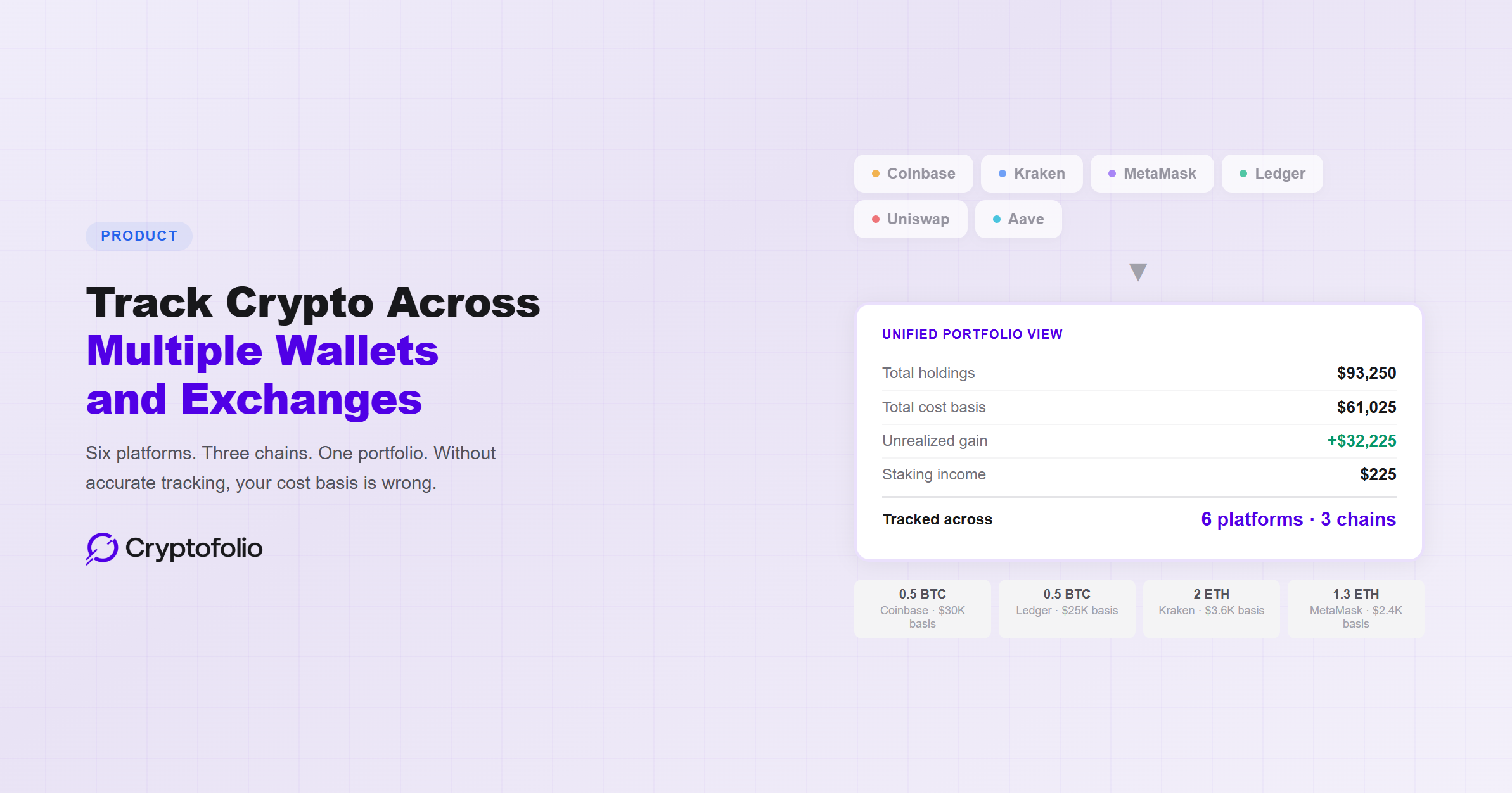
You bought Bitcoin on Coinbase. Moved some to a Ledger for long-term storage. Opened a Kraken account to trade altcoins. Connected MetaMask to use Uniswap and Aave. Bridged ETH to Arbitrum for lower fees. Staked SOL on a separate wallet.
Six platforms. Three chains. One portfolio. And no single app that can see all of it.
This is the reality for most crypto investors in 2026. Between multiple exchanges, self-custody wallets, hardware devices, and DeFi protocols, it is common to have holdings spread across half a dozen platforms or more. Each platform only knows about the transactions that happened on its own system. Your Coinbase account has no idea what you did on Uniswap. Your Ledger does not know what you paid on Kraken. And none of them talk to each other.
If all you want is a balance, this is manageable. Open each app, add up the numbers. But if you want to know what you actually made, what your cost basis is, what your tax liability looks like, or whether you should harvest losses before year end, the fragmentation is not just inconvenient. It is a real problem that leads to wrong numbers, overpaid taxes, and missed opportunities. For a deeper look at exactly what separates a balance tracker from a full portfolio tracker, see our balance tracker vs. portfolio tracker guide.
Why Fragmentation Breaks More Than You Think
The issue is not just that your holdings are in different places. It is that the data needed to calculate your real performance exists in pieces across those places, and no single platform has all of it.
Here is what breaks when your crypto is spread across multiple platforms:
Cost basis gets lost at every transfer. When you move ETH from Coinbase to MetaMask, MetaMask has no record of what you paid on Coinbase. The original purchase price, the date you acquired it, and any fees you paid at acquisition all disappear from the perspective of the receiving platform. When you eventually sell, your cost basis is gone unless you maintained it yourself. For a deep dive on exactly how and why transfers break cost basis, see our transfer guide.
Each platform has its own lot queue. Under the IRS's wallet-by-wallet tracking rule (Revenue Procedure 2024-28), each exchange account and wallet maintains its own independent FIFO lot queue. When you sell Bitcoin from Kraken, the system only looks at lots held in your Kraken account. You cannot reach into your Coinbase or Ledger lots to find a more favorable cost basis. Where your crypto sits determines which lots are available to sell. For a full breakdown of how FIFO, LIFO, and Specific Identification work under wallet-level rules, see our accounting methods guide. Since January 1, 2025, basis tracking is required per wallet, not pooled across them. See what the wallet-by-wallet rules actually require.
DeFi creates invisible complexity. Every swap on Uniswap, every staking deposit on Aave, every liquidity pool entry on Curve generates taxable events that only exist on-chain. No centralized exchange sees them. No 1099-DA covers them. If you are not pulling on-chain data and classifying these transactions correctly, entire categories of your portfolio activity are untracked. For the full breakdown of DeFi tax treatment, see our DeFi tax guide.
Fees fragment across every platform. You paid gas fees in ETH on Ethereum, gas fees in AVAX on Avalanche, trading fees on Kraken in USD, and slippage on Uniswap swaps. Each of these is either a taxable disposition (gas fees) or a cost basis adjustment (exchange fees). Tracking them requires pulling data from every platform you touched. Miss any of them and your P&L is off.
Broker reporting covers only part of the picture. Your 1099-DA from Coinbase reports the gross proceeds from sales you made on Coinbase. It does not report anything that happened on Kraken, MetaMask, Uniswap, or your Ledger. The IRS receives one slice of your activity from each exchange. You are responsible for assembling the complete picture.
The Spreadsheet Approach (And Where It Breaks)
Many crypto investors start with a spreadsheet. It seems reasonable: one tab per exchange, one tab per wallet, columns for date, asset, quantity, price, fees. Manual entry after each transaction.
This works when your activity is simple. If you bought BTC on one exchange and held it there, a spreadsheet is fine.
It stops working the moment your activity gets even moderately complex. Here is where the spreadsheet breaks down:
Transfers require manual linking. Every time you move crypto between platforms, you need to find the withdrawal on the sending side and the deposit on the receiving side, confirm the amounts match (minus gas fees), and carry over the correct cost basis. If you made 20 transfers in a year, that is 20 pairs of transactions you need to match by hand.
DeFi transactions are hard to categorize. A single yield farming session on Aave or Curve can generate a deposit, multiple reward claims, and a withdrawal, each with different tax treatment. Entering these manually requires understanding the tax classification of each event. Most people either enter them wrong or skip them entirely.
FIFO calculations across wallets are error-prone. When you sell from one wallet, you need to look at that specific wallet's lot queue, identify the oldest lot, calculate the gain or loss, and update the remaining lots. Doing this by hand across six wallets and hundreds of transactions is where errors creep in.
It does not scale. Ten transactions per month is manageable. A hundred per month, which is common for anyone active in DeFi, is not. And once you fall behind, reconstructing months of missing data is exponentially harder than keeping up in real time.
You have no visibility into unrealized positions. A spreadsheet tracks what happened. It does not tell you what is happening now. To see your current unrealized gains and losses across every wallet, you would need to pull live prices, match them against your lot-level cost basis, and recalculate continuously. At that point, you have built a portfolio tracker.
What a Multi-Wallet Tracking Solution Needs to Do
The challenge is not just aggregating balances. Any price-fetching app can show your total holdings across wallets. The hard part is maintaining accurate cost basis, lot-level data, and transaction classification across every connected account, in real time.
Here is what actually matters:
Import full history, not just current balances. When you connect a wallet, the tracker needs to pull your entire transaction history back to the wallet's creation date. If it only starts tracking from the day you connect, every prior transaction has unknown cost basis, and your performance data is wrong from day one. This is the start-from-connection problem that many trackers get wrong.
Detect and link transfers automatically. When ETH leaves your Coinbase account and arrives in your MetaMask wallet 10 minutes later, the tracker needs to recognize this as a self-transfer, not a sale. It needs to carry the cost basis from the Coinbase lot queue to the MetaMask lot queue without creating a phantom taxable event.
Maintain per-wallet lot queues. Each exchange account and wallet needs its own independent FIFO queue that tracks every lot with its acquisition date, cost basis, and quantity. When you sell from a specific wallet, the tracker should consume lots from that wallet's queue only. This is an IRS requirement under Revenue Procedure 2024-28, not a nice-to-have feature.
Parse DeFi protocol interactions. Staking deposits, LP entries and exits, token swaps, bridge transfers, airdrops, and reward claims each require different cost basis treatment. A tracker that classifies an Aave deposit as "sent to unknown address" is not parsing DeFi correctly. For a detailed look at what it takes to track cost basis across a cross-chain bridge, including wrapped tokens and fee handling, see our bridge cost basis guide.
Track fees as first-class data. Every gas fee paid on any chain needs to be captured as a taxable disposition, with the correct lot consumed from the correct wallet's queue. Exchange trading fees need to be captured as cost basis adjustments. If fees are ignored or approximated, the numbers will not hold up to review.
Flag what it cannot resolve. No tracker can automatically classify every transaction on every protocol. When the system encounters an unrecognized protocol interaction or an ambiguous transaction, it should flag it for your review rather than silently guessing. A wrong classification is worse than an unclassified transaction you can fix yourself.
A Practical Example
Say you have holdings across four platforms:
Coinbase: 0.5 BTC (cost basis $30,000, current value $42,500)
Kraken: 2 ETH (cost basis $3,600, current value $5,000)
MetaMask: 1 ETH transferred from Coinbase (original cost $2,200), plus 0.3 ETH in staking rewards from Aave (fair market value at receipt $225, current value $750)
Ledger: 0.5 BTC transferred from Coinbase (original cost $25,000, current value $42,500)
If you want to sell 0.5 BTC, the lot you sell from matters. Selling from Coinbase triggers a $12,500 gain. Selling from Ledger triggers a $17,500 gain. The wallet-by-wallet rule means you cannot choose across wallets. You sell from whichever platform holds the BTC you are selling, and that platform's lot queue determines the cost basis. For more on how lot selection and accounting methods affect your tax outcome, see our FIFO vs. LIFO guide.
This is information a balance tracker cannot provide. And without it, you are making sell decisions, tax-loss harvesting decisions, and filing decisions without the data you need.
Where This Is Heading
The multi-wallet tracking problem is not getting simpler. The crypto ecosystem is expanding to more chains, more protocols, and more platform types. Layer 2 networks, restaking protocols, cross-chain bridges, and new DeFi primitives all add complexity.
At the same time, the regulatory environment is tightening. The IRS now requires wallet-by-wallet cost basis tracking. Form 1099-DA gives the IRS direct visibility into your exchange activity. The SEC's recent token taxonomy is creating clearer rules for asset classification. All of this means more reporting requirements, not fewer, and more consequences for getting it wrong.
The investors who will navigate this well are the ones who have their data organized before they need it, not the ones scrambling to reconstruct a year of fragmented activity in April.
How Cryptofolio Handles This
Cryptofolio connects to your exchanges via read-only API and your wallets via on-chain data. It imports your complete transaction history from every connected account back to each wallet's creation date. Transfers between your own platforms are detected and linked automatically, carrying cost basis from the source to the destination.
Each wallet and exchange maintains its own lot queue, compliant with the IRS's per-wallet tracking requirement. DeFi protocol interactions are parsed and classified. Gas fees on every chain are captured as taxable dispositions. When a transaction cannot be fully resolved automatically, Cryptofolio flags it for your review rather than silently assigning an incorrect classification.
The result: one dashboard that shows your actual position across every platform. Not just what you hold. What you paid, what you earned, what you lost, and what you owe. Updated in real time, not reconstructed once a year.
Your crypto is everywhere. Your data shouldn't be.
Cryptofolio brings every wallet, exchange, and chain into one place with accurate cost basis, lot-level tracking, and real-time P&L.
The Bottom Line
If your crypto lives on one exchange and you have never moved it, tracking is simple. For everyone else, the multi-wallet, multi-chain, multi-protocol reality of crypto in 2026 requires a system that can see across every platform, link transfers, maintain per-wallet lot queues, and classify every transaction type correctly.
The balance is the easy part. Knowing what you actually made is the hard part. And that is the part that matters for every decision you make with your portfolio, from selling and rebalancing to harvesting losses and filing your taxes.
Get your tracking right once. Then every other decision gets easier.
Disclaimer: This article is for informational purposes only and does not constitute legal, tax, financial, or investment advice. Consult a qualified professional for advice on your individual circumstances.